Everyman's Library, no. 460. Essays and belles lettres

Standalone books

Reflections on the revolution in France
Edmund Burke's Reflections on the Revolution in France, written and published during 1789-90, has become a classic of English conservatism, and that is the reason it is still being read nearly two hundred years later. John Pocock's edition of Burke's Reflections is two classics in …
A philosophical enquiry into the origin of our ideas of the sublime and beautiful
The "Philosophical Enquiry" is a study of the relationship between strong feelings and forms of art, that considers the inspired persuasiveness of certain kinds of writing alongside experience of the natural landscape, and is gradually being recognized as an important work of aesthetic theory. This …


Reflections on the revolution in France, and on the proceedings in certain societies in London relative to that event

The Portable Edmund Burke
The intellectual wellspring of modern political conservatism, Edmund Burke is also considered a significant figure in aesthetic theory and cultural studies. As a member of the House of Commons during the late eighteenth century, Burke shook Parliament with his powerful defense of the American Revolution …


Essays
Includes selections from his works on America and the British Empire, Ireland and Catholic emancipation, English constitutional affairs, India and the impeachment of Hastings, and the French Revolution.

Thoughts on the cause of the present discontents
Thoughts on the Cause of the Present Discontents is a political pamphlet by the Irish politician and philosopher Edmund Burke, first published on 23 April 1770. The subject is the nepotism of King George III and the influence of the Court on the House of …



On taste
On taste: A philosophical inquiry into the origin of our ideas of the sublime and beautiful, with several other additions. Reflections on the French Revolution: Reflections on the revolution in France and on the proceedings in certain societies in London relative to that event in …


Optimal Muscle Performance and Recovery
Now in a revised and expanded second edition, Optimal Muscle Recovery is a valuable training guide-a must-have for serious endurance athletes or anyone looking to train harder and recover faster. Author Ed Burke is one of the country's leading exercise physiologists, having worked with professional …


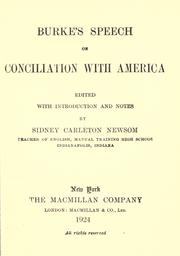
Speech on conciliation
Edmund Burke, member of the British House of Commons for Bristol, gave this speech on conciliation with the American colonies on March 22, 1775, which was published May 1775. It was an early twentieth century model for English rhetoric, particularly in America. Besides being a …


Two letters addressed to a member of the present Parliament, on the proposals for peace with the regicide Directory of France


A letter from the Right Hon. Edmund Burke, M.P. in the Kingdom of Great Britain


A treatise on the first principles of Christianity [signed by E.B., V.G. Que.]


Forgotten truths, selections from the speeches and writings of Edmund Burke, with biographical sketch

Further reflections on the revolution in France
In his famous Reflections on the Revolution in France (1790), Edmund Burke excoriated French revolutionary leaders for recklessly destroying France's venerable institutions and way of life. But his war against the French intelligentsia did not end there, and Burke continued to take pen in hand …


Indagación filosófica sobre el origen de nuestras ideas acerca de lo sublime y de lo bello
A Philosophical Enquiry into the Origin of Our Ideas of the Sublime and Beautiful is a 1757 treatise on aesthetics written by the Anglo-Irish politician Edmund Burke. It was the first complete philosophical exposition for separating the beautiful and the sublime into their own respective …


