Michael David Warner is an American literary critic, social theorist, and Seymour H. Knox Professor of English Literature and American Studies at Yale University. He also writes for Artforum, The Nation, The Advocate, and The Village Voice. He is the author of Publics and Counterpublics, The Trouble with Normal: Sex, Politics, and the Ethics of Queer Life, The English Literatures of America, 1500–1800, Fear of a Queer Planet, and The Letters of the Republic. He edited The Portable Walt Whitman and American Sermons: The Pilgrims to Martin Luther King, Jr.
From Wikipedia · CC BY-SA 4.0
10 books in our catalogue.
1999
240 pages
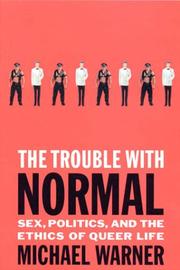
"Is gay marriage good for gays? Are queer people better off when they see themselves as "normal" Americans? What is lost when gays go mainstream? What, after all, is The Trouble With Normal? Here, Michael Warner, argues that gay marriage and other moves toward normalcy …
1993
334 pages
HistoryPhilosophy & ReligionPolitics & Society
1988
204 pages
HistoryPolitics & Society
2014
406 pages
History
A century ago, almost any state could be competitive at espionage. Fifty years ago, only the Cold War alliances clustered around the two superpowers could. Today, however, many states can do so once again, and private entities and even individuals can gather secrets and manipulate …
2002
334 pages
Politics & Society
"By combining historical analysis, theoretical reflection, and extended case studies, Publics and Counterpublics shows how the idea of a public works as a formal device in modern culture and traces its implications for contemporary life. Michael Warner offers a revisionist account at the junction of …
1990
215 pages
HistoryPolitics & Society
Overview: The subject of Michael Warner's book is the rise of a nation. America, he shows, became a nation by developing a new kind of reading public, where one becomes a citizen by taking ones place as writer or reader. At heart, the United States …
2020
326 pages
Politics & Society
2010
345 pages
"'What does it mean to say that we live in a secular age?' This apparently simple question opens into the massive, provocative, and complex A Secular Age, where Charles Taylor positions secularism as a defining feature of the modern world, not the mere absence of …