David M. Glantz is an American military historian known for his books on the Red Army during World War II and as the chief editor of The Journal of Slavic Military Studies.
From Wikipedia · CC BY-SA 4.0
35 books in our catalogue.
1995
414 pages
History
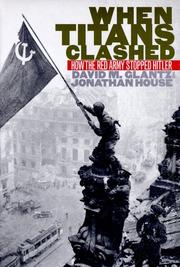
By the time Pearl Harbor had ripped apart America's peacetime pretensions, the German blitzkrieg had already blasted the Red Army back to the gates of Moscow. Yet, less than four years later, the Soviet hammer and sickle flew above the ruins of Berlin, stark symbol …
1999
479 pages
History
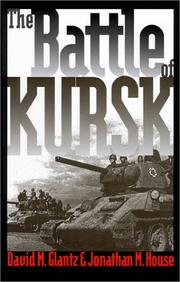
"Immense in scope, ferocious in nature, and epic in consequence, the Battle of Kursk witnessed (at Prokhorovka) one of the largest tank engagements in world history and led to staggering losses - including nearly 200,000 Soviet and 50,000 German casualties - within the first ten …
2004
807 pages
History
"In Stumbling Colossus, David Glantz explored why the Red Army was unprepared for the German blitzkrieg that nearly destroyed it and left more than 4 million of its soldiers dead by the end of 1941. In Colossus Reborn he recounts the miraculous resurrection of the …
2009
History
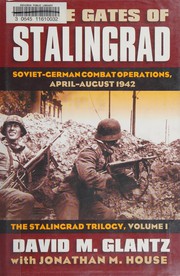
The confrontation between German and Soviet forces at Stalingrad was a titanic clash of armies on an unprecedented scale—a campaign that was both a turning point in World War II and a lasting symbol of that war's power and devastation. Yet despite the attention lavished …
2002
660 pages
History
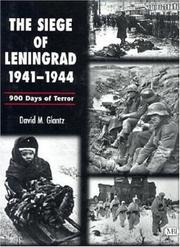
"One of the first major Soviet cities threatened by the German blitzkrieg, Leningrad was as much a symbolic target as it was a strategic one for Adolf Hitler, who fully expected the birthplace of the Russian Revolution to be reduced to rubble quickly and with …
2010
History
"This study exploits a wealth of Soviet and German archival materials, including the combat orders and operational records of the German OKW, OKH, army groups, and armies of the Soviet Stavka, the Red Army General Staff, the Western Main Direction Command, the Western, Central, Reserve, …
2001
353 pages
History
"The Red Army's Belorussian operation in the summer of 1944 was unprecedented in terms of its scale, scope, and strategic consequences. For the first time in the war, the Soviet Stavka (High Command) planned for a summer campaign consisting of a series of massive and …
2012
624 pages
History
"German Ground Forces of World War II offers the first comprehensive order of battle for German ground troops throughout the Second World War, from the invasion of Poland on September 1, 1939, to the destruction of the last remnants of Germany's Wehrmacht and Waffen SS …
1998
374 pages
History
Drawing on evidence never before seen in the West, including combat records of early engagements, David Glantz claims that in 1941 the Red Army was poorly trained, inadequately equipped, ineptly organized, and consequently incapable of engaging in large-scale military campaigns - and both Hitler and …
1999
421 pages
Biography & MemoirHistory
Illuminating the painful progress of Operation Mars with vivid battle scenes and numerous maps and illustrations, Glantz presents Mars as a major failure of Zhukov's renowned command. Yet, both during and after the war, that failure was masked from public view by the successful Stalingrad …
2003
256 pages
History
A comprehensive guide to the battle for the Ukraine from the Soviet perspective during the winter of 1943-1944. This volume is an unexpurgated translation of the originally classified Soviet General Staff Study No.14.
2005
309 pages
History
This book contains the companion appendixes to Colossus Reborn by David Glantz published in 2005 by University Press of Kansas.
2006
448 pages
History
"Germany's Eastern Front in World War II saw many campaigns and battles that have been forgotten by a Soviet Union that tried to hide its military failures. The Red Army's invasion of Romania in April and May 1944 was one such campaign, which produced nearly …
1994
446 pages
History
The historical record of the development and use of airborne forces has hitherto been blurred by neglect, secrecy and misinformation. This book uncovers the truth and sets the record straight. Using newly released and formerly classified Soviet archival sources and German sources never before seen …