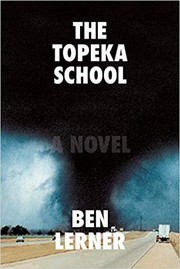
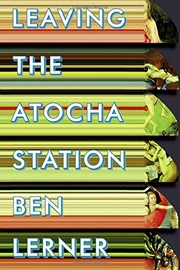
Benjamin S. Lerner is an American poet, novelist, essayist, and critic. The recipient of fellowships from the Fulbright, Guggenheim, and MacArthur Foundations, Lerner's work has been a finalist for the National Book Award for Poetry, the National Book Critics Circle Award in fiction, and the Pulitzer Prize for Fiction. Lerner teaches at Brooklyn College, where he was named a Distinguished Professor of English in 2016.
From Wikipedia · CC BY-SA 4.0
6 books in our catalogue.
2014
250 pages
Literary & Classics
A beautiful and utterly original novel about making art, love, and children during the twilight of an empire. Ben Lerner's first novel, Leaving the Atocha Station, was hailed as "one of the truest (and funniest) novels. of his generation" (Lorin Stein, The New York Review …
2019
304 pages
General Fiction
The Topeka School is a 2019 novel by the American novelist and poet Ben Lerner about a high school debate champion from Topeka, Kansas in the 1990s. The book is considered both a bildungsroman and a work of autofiction, as the narrative incorporates many details …
2011
200 pages
Young Adult
Leaving the Atocha Station (2011) is the debut novel by American poet and critic Ben Lerner. It won the 2011 Believer Book Award.
2016
96 pages
Poetry & Drama
"No art has been denounced as often as poetry. It's even bemoaned by poets: "I, too, dislike it," wrote Marianne Moore. "Many more people agree they hate poetry," Ben Lerner writes, "than can agree what poetry is. I, too, dislike it and have largely organized …
2006
127 pages
Poetry & Drama
"Angle of Yaw, Ben Lerner's ambitious second book of poetry, is an extended meditation on the commercialization of public space and speech. Combining philosophical insight with poetic experiment, political outrage with personal experience, Lerner's prose poems and lyrical sequences examine how technologies of viewing - …
2004
53 pages
"The Lichtenberg Figures, winner of the Hayden Carruth Award for Emerging Poets, is a sonnet sequence that interrogates the relationships between language and memory, violence and form. The book takes its title from the fernlike patterns that sometimes appear (and quickly fade) in the aftermath …