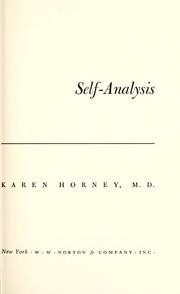
Karen Horney was a German psychoanalyst who practiced in the United States during her later career. Her theories questioned some traditional Freudian views, specifically in theories of sexuality and of the instinct orientation of psychoanalysis. Horney is also credited with founding feminist psychology in response to Freud's theory of penis envy. She disagreed with Freud about inherent differences in the psychology of men and women, and like Alfred Adler, she traced such differences to society and culture rather than biology.
From Wikipedia · CC BY-SA 4.0
14 books in our catalogue.
1967
269 pages
Politics & SocietyPsychology & Self-Help
"Because the role of woman as a contributing member of society comes increasingly under scrutiny, Karen Horney's thoughts and theories about feminine psychology are particularly relevant to our day. In this new collection of papers, many previously unavailable in English, Karen Horney brings to the …
1942
309 pages
Psychology & Self-Help
This book shows how and to what extent the individual can psychoanalyze himself. More and more, people are turning to psychoanalysis not because they suffer from depressions, phobias, or comparable disorders but because they feel that factors within themselves are holding them back or injuring …
1937
299 pages
Psychology & Self-Help
1950
391 pages
Psychology & Self-Help
Neurosis and Human Growth: The Struggle Toward Self-Realization is a 1950 book by the German-American psychoanalyst Karen Horney. It was the last book she published and the major work of her later years. In it she gives the fullest statement of the theory of neurosis …
1945
250 pages
Psychology & Self-Help
1939
313 pages
Psychology & Self-Help
1980
271 pages
Biography & MemoirPsychology & Self-Help
2000
369 pages
Politics & SocietyPsychology & Self-Help
"This volume of writings by the psychoanalyst Karen Horney (1885-1952) completes the publication of her previously unpublished and uncollected work. It includes pieces on feminine psychology and the relations between the sexes as well as on other aspects of psychoanalytic theory. The editor's introductions set …
1946
259 pages
Psychology & Self-Help
1987
128 pages
Psychology & Self-Help
1963
Psychology & Self-Help
2013
200 pages
Psychology & Self-Help
2011
432 pages
Psychology & Self-Help
1999
272 pages
Psychology & Self-Help