Richard Sennett is an American sociologist who is the Centennial Professor of Sociology at the London School of Economics and former University Professor of the Humanities at New York University. He is currently a Senior Fellow of the Center on Capitalism and Society at Columbia University. Sennett has studied social ties in cities, and the effects of urban living on individuals in the modern world.
From Wikipedia · CC BY-SA 4.0
21 books in our catalogue.
1998
176 pages
In the brave new world of the "flexible" corporation, Richard Sennett observes, workers at all levels are regarded as wholly disposable, and they have responded in kind, ceasing to think in terms of any long-term relationship with the organizations they work for. This, he argues, …
1977
408 pages
Biography & MemoirPolitics & Society
A landmark study of urban society, reissued for the 40th anniversary of the original publication with a new epilogue by the author. A sweeping, farsighted study of the changing nature of public culture and urban society, The Fall of Public Man spans more than two …
1970
198 pages
Art & Photography
The excitement of the brilliantly innovative book is that it challenges the reader to revise his concept of order—and to consider the seemingly disparate problems of the individual personality and the urban society in the light of a fresh, unified framework that has the shock …
2008
336 pages
Philosophy & ReligionPolitics & SocietyPsychology & Self-Help
Why do people work hard, and take pride in what they do? This book, a philosophically-minded enquiry into practical activity of many different kinds past and present, is about what happens when people try to do a good job. It asks us to think about …
1972
275 pages
Politics & Society
This book deals with class not as a matter of dollars or statistics but as a matter of emotions. Richard Sennett and Jonathan Cobb isolate the “hidden signals of class” through which today’s blue-collar worker measures his own value against those lives and occupations to …
1994
432 pages
HistoryPolitics & Society
This vivid history of the city in Western civilization tells the story of urban life through bodily experience. Flesh and Stone is the story of the deepest parts of life? how women and men moved in public and private spaces, what they saw and heard, …
1980
207 pages
This book is a study of both how we experience authority and how we might experience it differently. Sennett explores the bonds that rebellion against authority paradoxically establishes, showing how this paradox has been in the making since the French Revolution and how today it …
2003
304 pages
Psychology & Self-Help
The powerful case for a society of mutual respect. As various forms of social welfare were dismantled though the last decade of the twentieth century, many thinkers argued that human well-being was best served by a focus on potential, not need. Richard Sennett thinks differently. …
2018
394 pages
Art & Photography
Making and Dwelling is the definitive statement on cities by the renowned public intellectual Richard Sennett. In this sweeping work, he traces the anguished relation between how cities are built and how people live in them, from ancient Athens to twenty-first-century Shanghai. He shows how …
2020
160 pages
Art & PhotographyPolitics & Society
Rethinking the open city Planners, privatisation, and police surveillance are laying siege to urban public spaces. The streets are becoming ever more regimented as life and character are sapped from our cities. What is to be done? Is it possible to maintain the public realm …
1990
266 pages
Art & PhotographyHistory
A fascinating study of the search for shelter and the fear of exposure to strangers and new experiences in Western culture and how these two concerns have shaped the physical fabric of the city. Sennett's exploration of the development of urban society and structure jumps …
2009
323 pages
Politics & Society
Discusses why people tend to avoid social engagement with those unlike themselves, why increased cooperation is necessary to make society prosper, and the skills necessary for strengthening cooperation.
1986
287 pages
General Fiction
Ablaze with intellectual and social change, Paris in the 1830s and 1840s beckons to two English brothers-Frederick and Charles Courtland, an architect and a priest-each of whom is struggling for self-definitionand social recognition. Of their lives and this world Sennett has made a remarkable work …
2010
336 pages
HistoryPsychology & Self-Help
Living with people who differ -- racially, ethnically, religiously, or economically -- is the most urgent challenge facing civil society today. We tend socially to avoid engaging with people unlike ourselves, and modern politics encourages the politics of the tribe rather than of the city. …
1984
221 pages
General Fiction
A young cellist is headed for success based upon his technical mastery of his instrument. But, he is stunted, detached from the music itself. It is through the music of Brahms that he seeks his release. Finally, he learns to allow the music to dominate …
1970
258 pages
Politics & Society
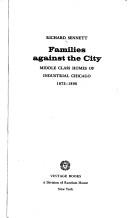
Families against the City portrays the life styles of middle class families in a Chicago community during the decades following the Civil War, when major American cities were experiencing massive development. The study focuses on Union Park, a section of Chicago that had been wealthy …
1969
430 pages
History
Research on the frontiers of urban studies was the subject of a conference on nineteenth-century cities held in November 1968 at Yale University. These papers from the conference attempt to define what is coming to be known as the new urban history. The cities studied …
1982
182 pages
General Fiction
The fictional memoirs of Tibor Grau, a leading Marxist thinker, recounts his public and private lives from the early revolutionist period to the time of Stalin, detailing his official career, philosophical development, and homosexuality.
1977
364 pages
Psychology & Self-Help
2014
116 pages
Richard Sennett'in düşünce hayatı insanların şehirlerde nasıl yaşadıklarını araştırmakla geçmiştir. Bu kitapta bir araya getirdiği iki denemede kendi dönemlerinde dünyanın en büyük iki şehri olan Venedik ve Paris'i ziyaret ederek sürgünlerin hem coğrafi hem de manevi mekân içindeki durumu üzerine düşünüyor. İlk bölümde Rönesans dönemi …