Walter Scheidel is an Austrian historian who teaches ancient history at Stanford University, California. Scheidel's main research interests are ancient social and economic history, pre-modern historical demography, and comparative and transdisciplinary approaches to world history.
From Wikipedia · CC BY-SA 4.0
9 books in our catalogue.
2017
504 pages
Business & EconomicsHistoryPolitics & Society
"Are mass violence and catastrophes the only forces that can seriously decrease economic inequality? To judge by thousands of years of history, the answer is yes. Tracing the global history of inequality from the Stone Age to today, Walter Scheidel shows that inequality never dies …
2019
688 pages
Business & EconomicsHistory
"In this book, Walter Scheidel provides a unique take on the perennial debates about the rise of the west. His main argument is straightforward and provocative: the fact that nothing like the Roman Empire ever again emerged in Europe was a crucial precondition for modern …
2001
286 pages
History
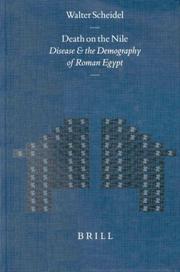
"A pioneering comparative and multidisciplinary study of the interaction between local disease environments and and demographic structure, this book breaks new ground in reconstructing the population history of Egypt during the Roman period and beyond." "Drawing on a wide range of sources from ancient census …
2009
400 pages
History
"The world's first known empires took shape in Mesopotamia between the eastern shores of the Mediterranean Sea and the Persian Gulf, beginning around 2350 BCE. The next 2,500 years witnessed sustained imperial growth, bringing a growing share of humanity under the control of ever-fewer states. …
2016
328 pages
HistoryPolitics & Society
2009
240 pages
History
"Two thousand years ago, up to one-half of the human species was contained within two political systems, the Roman empire in western Eurasia (centered on the Mediterranean Sea) and the Han empire in eastern Eurasia (centered on the great North China Plain). Both empires were …
2015
378 pages
History
"Two thousand years ago, the Qin/Han and Roman empires were the largest political entities of the ancient world, developing simultaneously yet independently at opposite ends of Eurasia. Although their territories constituted only a small percentage of the global land mass, these two Eurasian polities controlled …