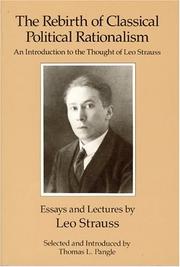
Leo Strauss was a German-American political philosopher and historian of philosophy whose work greatly influenced twentieth-century political theory in the United States and the study of classical political thought. He is known best for his interpretation of ancient and medieval philosophy, his account of classical natural right, and his claim that philosophers often wrote esoterically, presenting different teachings to general and specialist readers.
From Wikipedia · CC BY-SA 4.0
28 books in our catalogue.
1948
228 pages
Philosophy & ReligionPolitics & Society
This title is Leo Strauss's classic reading of Xenophon's dialogue 'Hiero', or 'Tyrannicus', in which the tyrant Hiero and the poet Simonides discuss the advantages and disadvantes of exercising tyranny.
1950
326 pages
Politics & Society
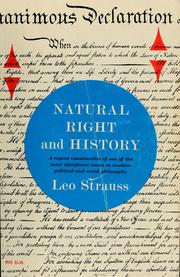
In this classic work, Leo Strauss examines the problem of natural right and argues that there is a firm foundation in reality for the distinction between right and wrong in ethics and politics. On the centenary of Strauss's birth, and the fiftieth anniversary of the …
1963
849 pages
HistoryPolitics & Society
1968
276 pages
HistoryPolitics & Society
1952
204 pages
Language & ReferencePhilosophy & ReligionPolitics & Society
Persecution and the Art of Writing is a 1941 essay, later included in an anthology of the same name, by Leo Strauss.
1958
348 pages
Politics & Society
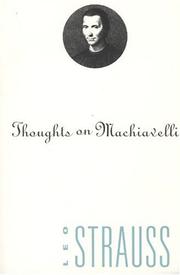
Thoughts on Machiavelli is a book by Leo Strauss first published in 1958. The book is a collection of lectures he gave at the University of Chicago in which he dissects the work of Niccolò Machiavelli. The book contains commentary on Machiavelli's The Prince and …
1989
368 pages
HistoryPhilosophy & ReligionPolitics & Society
1999
336 pages
Philosophy & Religion
1983
260 pages
HistoryPolitics & Society
1964
245 pages
Politics & Society
The City and Man consists of provocative essays by the late Leo Strauss on Aristotle's Politics, Plato's Republic, and Thucydides' Peloponnesian Wars. Together, the essays constitute a brilliant attempt to use classical political philosophy as a means of liberating modern political philosophy from the stranglehold …
1966
321 pages
HistoryPhilosophy & ReligionPolitics & Society
1936
172 pages
Politics & Society
1989
285 pages
HistoryPolitics & Society
1988
316 pages
Politics & Society
"All political action has . . . in itself a directedness towards knowledge of the good: of the good life, or of the good society. For the good society is the complete political good. If this directedness becomes explicit, if men make it their explicit …
1954
356 pages
HistoryPolitics & Society
2001
236 pages
Philosophy & ReligionPolitics & Society
2001
320 pages
HistoryPhilosophy & ReligionPolitics & Society
2018
272 pages
HistoryPhilosophy & ReligionPolitics & Society
1935
138 pages
Philosophy & Religion
1965
351 pages
Philosophy & Religion
1975
186 pages
"In this intensive book-by-book examination, Leo Strauss arrives at a general interpretation of the Laws within the Platonic corpus. Through careful scrutiny of the actions and gestures of the speakers, analysis of the dramatic development and structure of the text, and penetrating discussion of the …
1972
181 pages
Politics & Society
2001
799 pages
Philosophy & ReligionPolitics & Society
2011
167 pages
Philosophy & Religion
"Leo Strauss's The Political Philosophy of Hobbes deservedly ranks among his most widely acclaimed works. In it Strauss argues that the basis for Hobbes's natural and political science is his interest in "self-knowledge of man as he really is." The writings collected in this book, …
2013
22 pages
Politics & Society
2018
288 pages
Politics & Society