Toward a theory of instruction
1966
176 pages
Philosophy & ReligionPolitics & Society
Dewey 371.3 ISBN 0674897005 9780674897007 0674897013 9780674897014 OCLC 178108 608888336
Dewey 371.3 ISBN 0674897005 9780674897007 0674897013 9780674897014 OCLC 178108 608888336
Drawing on recent work in literary theory, linguistics, and symbolic anthropology, as well as cognitive and developmental psychology Professor Bruner examines the mental acts that enter into the imaginative creation of possible worlds, and he shows how the activity of imaginary world making undergirds human …
Jerome Bruner argues that the cognitive revolution, with its current fixation on mind as "information processor;" has led psychology away from the deeper objective of understanding mind as a creator of meanings. Only by breaking out of the limitations imposed by a computational model of …
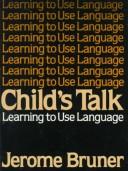
How does a child acquire language, and what may facilitate this learning? To carry out his investigations, Bruner went to the child's own setting for learning rather than observing children in a contrived video laboratory. For Bruner, language is learned by using it. Central to …
What we don't know about learning could fill a book - and it might be a schoolbook. In a masterful commentary on the possibilities of education, the eminent psychologist Jerome Bruner reveals how education can usher children into their culture, though it often fails to …
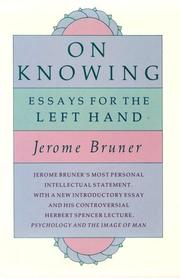
The left hand has traditionally represented the powers of intuition, feeling, and spontaneity. In this classic book, Jerome Bruner inquires into the part these qualities play in determining how we know what we do know; how we can help others to know-that is, to teach; …