M. Gessen is a Russian American journalist, author, and translator who has written extensively on LGBT rights and authoritarian regimes. Gessen received the 2026 Pulitzer Prize for Opinion Writing for their articles in The New York Times, which the Pulitzer committee called "an illuminating collection of reported essays on rising authoritarian regimes that draw on history and personal experience to probe timely themes of oppression, belonging and exile."
From Wikipedia · CC BY-SA 4.0
13 books in our catalogue.
2012
320 pages
Biography & MemoirPolitics & Society
This is the chilling account of how a low-level, small-minded KGB operative ascended to the Russian presidency and, in an astonishingly short time, destroyed years of progress and made his country once more a threat to her own people and to the world. Handpicked by …
2017
536 pages
Biography & MemoirHistoryPolitics & Society
Journalist Masha Gessen follows the lives of four people born at what promised to be the dawn of democracy. Each of them came of age with unprecedented expectations, some as the children and grandchildren of the very architects of the new Russia, each with newfound …
2020
296 pages
Politics & Society
2009
260 pages
Biography & Memoir
A sociological and anthropological biography of Grigori Perelman, a Russian mathematician who proved Poincare's Conjecture, becoming the first person to win a million-dollar prize (which he refused to accept) from by the Clay Mathematical Institute for solving one of their Millennium Problems.
2015
297 pages
"On April 15, 2013, two homemade bombs exploded near the finish line of the Boston marathon, killing three people and wounding more than 264 others. In the ensuing manhunt, Tamerlan Tsarnaev died, and his younger brother Dzhokhar was captured and ultimately charged on thirty federal …
2014
308 pages
Politics & Society
Drawing on access to the band's members and their families and associates, recreates the feminist punk activists' fierce act of political confrontation in Moscow, which made national headlines as they were punished for their act of defiance.
2004
352 pages
Biography & MemoirPolitics & Society
"In the 1930s, as waves of war and persecution were crashing over Europe, two young Jewish women began separate journeys of survival. One, a Polish-born woman from Bialystok, where virtually the entire Jewish community would soon be sent to the ghetto and from there to …
1997
211 pages
Politics & Society
The author examines "the ways in which intellectuals are finding an identity in the new Russia."--Cover.
2008
321 pages
Politics & SocietyScience & Nature
(Publisher-supplied data) In 2004 genetic testing revealed that Masha Gessen had a mutation that predisposed her to ovarian and breast cancer. The discovery initiated Gessen into a club of sorts: the small (but exponentially expanding) group of people in possession of a new and different …
2016
169 pages
History
"The story of the Jews in twentieth-century Russia as told through the strange history of the Soviet solution to the Jewish question. In 1929, the Soviet Union declared the area of Birobidzhan a homeland for Jews. In the late 1920s and early 1932, tens of …
2014
165 pages
Biography & MemoirPolitics & Society
1995
269 pages
Politics & Society
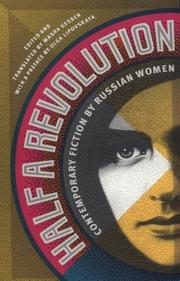
Nine stories by Russian women. In She Who Bears No Ill, a woman disfigured by a disease prefers to be locked up in a mental institution rather than be looked at with repugnance outside, while The Day of the Poplar Flakes describes the shoddy treatment …
2018
158 pages
Art & PhotographyHistory