Il giorno della civetta
1961
125 pages
General Fiction
The Day of the Owl is a crime novel about the Sicilian Mafia by Leonardo Sciascia, finished in 1960 and published in 1961 by Einaudi.
The Day of the Owl is a crime novel about the Sicilian Mafia by Leonardo Sciascia, finished in 1960 and published in 1961 by Einaudi.
""This letter is your death sentence. To avenge what you have done you will die." But what has Manno the pharmacist done? Nothing that he can think of. He takes the letter for a joke. The next day he and his hunting companion are both …
A man is shot dead as he runs to catch the bus in the piazza of a small Sicilian town. Captain Bellodi, the detective on the case, is new to his job and determined to prove himself. Bellodi suspects the Mafia, and his suspicions grow …
Una storia semplice is a short novel by Leonardo Sciascia. It was the last novel of the author to be published, shortly before his death. It is inspired by a real event, i.e. the theft of the Caravaggio Nativity with St. Francis and St. Lawrence, …
"Leonardo Sciascia was an outstanding and controversial presence in twentieth-century Italian literary and intellectual life. Writing about his native Sicily and its culture of secrecy and suspicion, Sciascia matched sympathy with skepticism, unflinching intelligence with a streetfighter's intransigent poise.". "Sciasia was particularly admired for his …
Sicily, 1783. In order to curry favour with the religious authorities in Naples, Abbot Vella invents an ancient Arabic chronicle called "The Council of Egypt", which justifies baronial privilege and restores to the kingdom of Naples all power over the island.
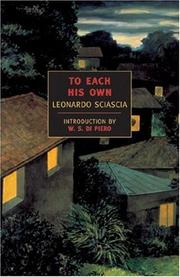
To Each His Own, first released in English as A Man's Blessing, is a 1966 detective novel by Leonardo Sciascia, in which an introverted academic, in attempting to solve a double-homicide, gets in too deep, with his naive interference in town politics.
"District Attorney Varga is shot dead. Then Judge Sanza is killed. Then Judge Azar. Are these random murders, or part of a conspiracy? Inspector Rogas thinks he might know, but as soon as he makes progress he is transferred and encouraged to pin the crimes …
A collection of four novellas. In these stories, illusions about ideology and history are lost in mirth and in suffering, and innocence is abandoned. Each novella has a historical moment: the Allied invasion of Sicily; the Spanish Civil War; the death of Stalin; and the …
"All my books taken together form one," Leonardo Sciascia conceded in his 1967 preface to Le parrocchie di Regalpetra; they form "a Sicilian book which probes the wounds of past and present and develops as the history of the continuous defeat of reason and of …