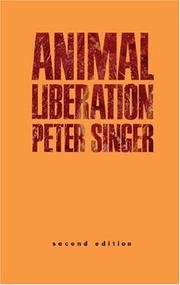
Animal liberation
1975
320 pages
Philosophy & Religion
Argues that those who oppose human suffering must also oppose inflicting suffering on animals.
Argues that those who oppose human suffering must also oppose inflicting suffering on animals.
For thirty years, Peter Singer's Practical Ethics has been the classic introduction to applied ethics. For this third edition, the author has revised and updated all the chapters and added a new chapter addressing climate change, one of the most important ethical challenges of our …
This is the right time to ask yourself: "What should I be doing to help?"For the first time in history, it is now within our reach to eradicate world poverty and the suffering it brings. Yet around the world, a billion people struggle to live …
"Peter Singer has succeeded in identifying the central vision that unifies Marx's thought. He thus makes it possible, in remarkably few pages, for us to grasp Marx's views as a whole, rather than as an economist or a social scientist. He explains alienation, historical materialism, …
In Ethics in the Real World, Singer shows that he is also a master at dissecting important current events in a few hundred words. In this book of brief essays, he applies his controversial ways of thinking to issues like climate change, extreme poverty, animals, …
This book eliminates any excuse for remaining ignorant of the outlines of Hegel's philosophy by providing a broad discussion of his important and influential ideas, and an account of his major works.
The Most Good You Can Do: How Effective Altruism Is Changing Ideas About Living Ethically is a 2015 Yale University Press book by moral philosopher and bioethicist Peter Singer describing and arguing for the ideas of effective altruism. As a follow-up to The Life You …
"Writings on an Ethical Life offers a comprehensive collection of Singer's best and most provocative writing, as chosen by Singer himself. Among the controversial subjects addressed are the moral status of animals, environmental accountability, abortion, infanticide, euthanasia, and the ultimate choice of living an ethical …
"The second edition sold a total of 19k copies since release in 2006, with strong sales (at least 1300 ) every year since release. The third edition has sold 6k copies since coming to market in December 2015. Solid 5-star reviews on Amazon, and #1 …
"Is there still anything worth living for? Is anything worth pursuing, apart from money, love, and caring for one's own family?" Internationally known social philosopher and ethicist Peter Singer has an answer to these and other questions in this compelling new volume. "If we can …
"The book encompasses four main global issues: climate change, the role of the World Trade Organization, human rights and humanitarian intervention, and foreign aid. Singer addresses each vital issue from an ethical perspective and offers alternatives to the state-centric approach that characterizes international theory and …
"Rethinking Life and Death is a book that only the distinguished philosopher Peter Singer could write - a book that creates nothing less than a new set of ethics for the next century. Singer shows just why our traditional ethic of life and death is …
What is ethics? Where do moral standards come from? Are they based on emotions, reason, or some innate sense of right and wrong? For many scientists, the key lies entirely in biology---especially in Darwinian theories of evolution and self-preservation. But if evolution is a struggle …
What is ethics? Where does it come from? Can we really hope to find any rational way of deciding how we ought to live? If we can, what would it be like, and how are we going to know when we have found it? This …
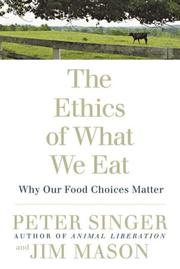
from the publisher: Peter Singer, the groundbreaking ethicist whom The New Yorker calls the most influential philosopher alive teams up again with Jim Mason, his coauthor on the acclaimed Animal Factories, to set their critical sights on the food we buy and eat: where it …
Explains the technologies of in vitro fertilization, embryo freezing, artificial insemination by donor, surrogate motherhood, and prospective methods of conception.
One of the world's most influential philosophers here confronts both the perils and potentials inherent in globalization. Every issue is considered from an ethical perspective, including climate change, foreign aid, human rights, immigration, and the responsibility to protect people from genocide and crimes against humanity. …
""What binds us pushes time away" wrote David Oppenheim to his future wife, Amalie Pollak, on March 24, 1905. Oppenheim, classical scholar, collaborator, then critic of Sigmund Freud, and friend and supporter of Alfred Adler, lived through the heights and depths of Vienna's twentieth-century intellectual …
"In this book, a renowned bioethicist argues that the political left must radically revise its outdated view of human nature. He shows how the insights of modern evolutionary theory, particularly on the evolution of cooperation, can help the left attain its social and political goals." …
Collection of historical, theoretical and applied articles on the ethical considerations in the treatment of animals by human beings.
Who are the Great Apes? They are chimpanzees, gorillas, orang-utans, and, according to co-editors Paola Cavalieri and Peter Singer, and a distinguished group of international contributors, they are persons. Yes, persons, capable of reflections, emotions, joy, as well as, all too often, pain. On the …
A thought-provoking look at how what we eat profoundly affects all living things--and how we can make more ethical food choices Five Principles for Making Conscientious Food Choices 1. Transparency: We have the right to know how our food is produced. 2. Fairness: Producing food …
"How can one person make the world a better place? Henry Spira's extraordinary life as an activist shows that an individual can make a difference. By thinking about how giant corporations might be vulnerable, he found ways to change their practices and save the lives …
Few subjects have generated so many newspaper headlines and such heated controversy in recent years as the treatment or non-treatment, of handicapped newborns. This book is a philosophical analysis of the subject, but accessibly written and rooted in practicalities and case studies throughout. The authors …
"Never has Peter Singer's Why Vegan? been more relevant and more necessary, in a world still reeling from a global pandemic crisis. Peter Singer's groundbreaking essay collection denounces human tyranny over animals and demonstrates the need for all of us to eliminate our dependence on …
'Does Anything Really Matter?' gives philosophers that were critized by Derek Parfit in his books 'On What Matters' an opportunity to respond to Parfit's criticisms. It includes essays on Parfit's views by Richard Chappell, Andrew Huddleston, Katarzyna de Lazari-Radek and Peter Singer, Bruce Russell, and …
This is an attempt by renowned philosopher Peter Singer and researcher Tom Gregg to assess how well Australia is doing as a global citizen. They take a look at Australia's record in five major areas: foreign aid, cooperation with other nations through the UN, trade, …
"In Defense of Animals: The Second Wave brings together the best current ethical thinking about animals. Edited by Peter Singer, who made "speciesism" an international issue in 1975 when he published Animal Liberation, this new book presents the state of the animal movement that his …
"In The Moral of the Story, Peter and Renata Singer bring together a collection of fiction, drama, and poetry that stimulates the reader to think about the perennial questions of ethics."--Jacket.