Martin Evan Jay is an American intellectual historian whose research interests connect history with Frankfurt School critical theory, social theory, cultural criticism, visual culture, and historiography.
From Wikipedia · CC BY-SA 4.0
10 books in our catalogue.
1971
382 pages
HistoryPolitics & Society
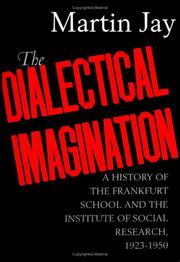
Herbert Marcuse, Erich Fromm, Max Horkheimer, Franz Neumann, Theodor Adorno, Leo Lowenthal—the impact of the Frankfurt School on the sociological, political, and cultural thought of the twentieth century has been profound. The Dialectical Imagination is a major history of this monumental cultural and intellectual enterprise …
1993
540 pages
Philosophy & Religion
"Long considered "the noblest of the senses," vision has increasingly come under critical scrutiny by a wide range of thinkers who question its dominance in Western culture. These critics, especially prominent in twentieth-century France, have challenged vision's allegedly superior capacity to provide access to the …
1994
806 pages
Politics & Society
Reproduces (translated into English) contemporary documents or writings with an introduction to each section.
1998
268 pages
Language & Reference
A selection of Martin Jay's recent writings on contemporary thought and culture, this is a book about ideas that matter - and about why ideas matter. Borrowing from Flaubert's notion of a dictionary of "received ideas" and Raymond Williams's explorations of the "keywords" of the …
2020
256 pages
Politics & Society
Assessing the legacy of the Frankfurt School in the twenty-first century Although successive generations of the Frankfurt School have attempted to adapt Critical Theory to new circumstances, the work done by its founding members continues in the twenty-first century to unsettle conventional wisdom about culture, …
2010
265 pages
HistoryPhilosophy & ReligionPolitics & Society
1984
192 pages
Biography & Memoir
2005
441 pages
HistoryPhilosophy & Religion
Few words in both everyday parlance and theoretical discourse have been as rhapsodically defended or as fervently resisted as "experience." Yet, to date, there have been no comprehensive studies of how the concept of experience has evolved over time and why so many thinkers in …