William Ury is an American author, academic, anthropologist, and negotiation expert. He co-founded the Harvard Program on Negotiation. Additionally, he helped found the International Negotiation Network with former President Jimmy Carter. Ury is the co-author of Getting to Yes with Roger Fisher, which set out the method of principled negotiation and established the idea of the best alternative to a negotiated agreement (BATNA) within negotiation theory.
From Wikipedia · CC BY-SA 4.0
25 books in our catalogue.
1981
200 pages
★ 4.00 · 10
Business & EconomicsPsychology & Self-Help
Getting to Yes offers a concise, step-by-step, proven strategy for coming to mutually acceptable agreements in every sort of conflict—whether it involves parents and children, neighbors, bosses and employees, customers or corporations, tenants or diplomats. Based on the work of the Harvard Negotiation Project, a …
1991
161 pages
Business & EconomicsPsychology & Self-Help
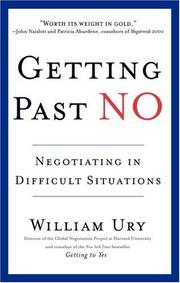
We all want to get to yes, but what happens when the other person keeps saying no? How can you negotiate successfully with a stubborn boss, an irate customer, or a deceitful coworker?In Getting Past No, William Ury of Harvard Law School's Program on Negotiation …
2007
272 pages
Psychology & Self-Help
No is perhaps the most important and certainly the most powerful word in the language. Every day we find ourselves in situations where we need to say No--to people at work, at home, and in our communities--because No is the word we must use to …
1991
181 pages
★ 4.09 · 11
2015
208 pages
Business & EconomicsPsychology & Self-Help
"William Ury, coauthor of the international bestseller Getting to Yes, returns with another groundbreaking book, this time asking: how can we expect to get to yes with others if we haven't first gotten to yes with ourselves? Renowned negotiation expert William Ury has taught tens …
1991
208 pages
Psychology & Self-Help
2011
232 pages
Psychology & Self-Help
1988
201 pages
Psychology & Self-Help
1999
250 pages
Using new archaeological and anthropological evidence, the author explains how to resolve conflicts in the home, work, and the world by identifying the "Third Side" of seemingly black-and-white arguments.
2004
268 pages
Table des matières consultable à l'adresse électronique
1984
137 pages
Politics & Society
2007
269 pages
Psychology & Self-Help
1989
356 pages
Politics & Society
2020
320 pages
Psychology & Self-Help
2015
186 pages
Business & Economics