George Gamow was a Soviet and American polymath, theoretical physicist and cosmologist. He was an early advocate and developer of Georges Lemaître's Big Bang theory. Gamow discovered a theoretical explanation of alpha decay by quantum tunneling, invented the liquid drop model, worked on radioactive decay, star formation, stellar nucleosynthesis, Big Bang nucleosynthesis, and predicted the existence of the cosmic microwave background radiation and molecular genetics.
From Wikipedia · CC BY-SA 4.0
28 books in our catalogue.
1947
340 pages
Science & Nature
This wonderful book is an introduction to the relationship between mathematics and the physical world. It explains elements of quantum theory, relativity, and purer mathematics, in a way apprenendible by young or uninitiated readers. (It was a delightful eye-opener to many 8th graders, doomed to …
1966
224 pages
HistoryScience & Nature
1965
186 pages
Science & Nature
1961
157 pages
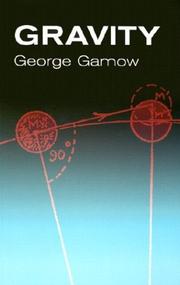
Classic and modern views of gravity including the Newtonian concept, Einstein's theory, and post-Einstein speculations.
2005
416 pages
Science & Nature
1970
178 pages
HistoryScience & Nature
This book gives a personal record of scientific adventures during thedevelopment of physics.
1960
605 pages
Science & Nature
1962
228 pages
Science Fiction
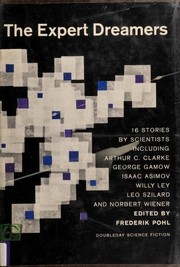
At the End of the Orbit - short story by Arthur C. Clarke (variant of Hate) On the Feasibility of Coal-Driven Power Stations - short story by O. R. Frisch A Feast of Demons - novelette by William Morrison The Heart on the Other Side …
1961
338 pages
HistoryScience & Nature
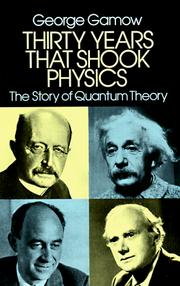
Dr. Gamow has written a view of physics which does not teach basic facts exclusively or dwell completely on biographical data, but rather, Dr. Gamow does both, for each chapter presents one or two great physicts and then discusses the nature and content of their …
1940
229 pages
Science & Nature
1964
208 pages
Science & Nature
1958
593 pages
Science & Nature
1952
147 pages
General Fiction
1988
338 pages
HistoryScience & Nature
History and explanation of how the central laws of physical science evolved from the Dark Ages to today's research on elementary particles.
1963
257 pages
Science & Nature
A biographical sketch of its past, present, and future, written for the general public.
1953
88 pages
Science & Nature
1960
591 pages
Science & Nature
1960
616 pages
Science & Nature
1966
254 pages
Science & Nature