The greedy triangle
1994
32 pages
Children's
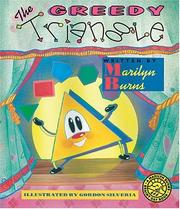
Dissatisfied with its shape, a triangle keeps asking the local shapeshifter to add more lines and angles until it doesn't know which side is up.
Dissatisfied with its shape, a triangle keeps asking the local shapeshifter to add more lines and angles until it doesn't know which side is up.
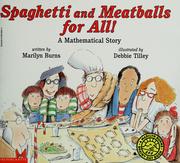
Mr. and Mrs. Comfort are having a family reunion! Mr. Comfort starts cooking up his famous spaghetti and meatballs, while Mrs. Comfort carefully arranges eight tables and thirty-two chairs so that everyone will have a seat.
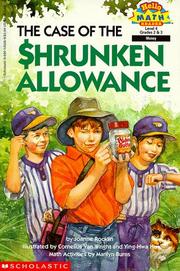
Mike and his friends try to figure out why the money in his allowance jar appears to be shrinking. Includes related math activities.
As two children take a walk with their grandfather, they use their counting skills to help answer a series of animal riddles. Includes related activities.
Text, illustrations, and suggested activities offer a common-senseapproach to mathematic fundamentals for those who are slightly terrified of numbers.
A collection of "hink pink" riddles, whose answers always have two words that rhyme, and form a definition.
Events, gags, magic tricks, and experiments to change one from a mathematical weakling into a mathematical heavyweight.
Describes when, why, and how people started to measure time and discusses such topics as time zones, biorhythms, and jet lag. Also includes instructions for a variety of related projects.
An informative look at food and what it does for us.
Events, gags, magic tricks, and experiments to change one from a mathematical weakling into a mathematical heavyweight.
Offers inspiring, practical, classroom-tested ideas for helping students learn mathematics through problem solving.
Deals with various aspects of childhood including family, school, money, legal rights, TV and movies, body language, and generally, how to make the most of childhood right now.
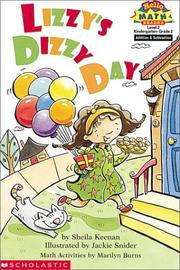
Although she thinks she is helping with her cousin's birthday party, Lizzy's mathematical reasoning does not always add up.
Presents a five-week unit of instruction for helping children construct their own understanding of our number system by learning about place value through grouping, counting, measuring, and graphing.
Challenging games, experiments, and investigations provide the context for students to gather sample data, predict outcomes, and then test their predictions. Students soon discover that they can assess the likelihood of an event actually occurring.
"So You Have to Teach Math? poses more than 100 questions that new and experienced K-6 teachers often ask themselves - and provides in-depth answers to these questions, no matter how large or how small. Marilyn Burns and Robyn Silbey’s responses are guaranteed to give …