The Great ideas program


A general introduction to the great books and to a liberal education
First in a set of reading plans for the Great books of the Western world series. Study guide.


Philosophy of law and jurisprudence
A thematic reading guide for the Great books of the Western world series.


Ethics, the study of moral values
A thematic reading plan for the Great books of the Western world series.

Standalone books
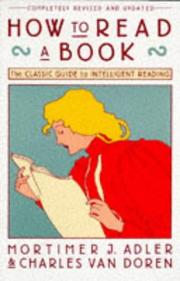
How to Read a Book
Esta guía clásica, que se publica por primera vez en España, analiza el acto de leer, ese proceso por el cual la mente, sin ayuda del exterior, se eleva gracias al poder de sus propios recursos: pasa de comprender menos a comprender más. El análisis …


Great ideas from the great books
Dr. Mortimer J. Adler, director of the Institute for Philosophical Research, author of How To Read A Book, How To Think About War And Peace GREAT IDEAS from the GREAT BOOKS with an introduction by William Benton, Chairman of the Board of Encyclopaedia Britannica, Inc. …

Aristotle for Everybody
"Adler traces 'in the simplest language and with occasional modern analogues, the logic and growth of Aristotle's basic doctrines.'" Publ Wkly "Aristotle taught logic to Alexander the Great and, by virtue of his philosophical works, to every philosopher since, from Marcus Aurelius, to Thomas Aquinas, …


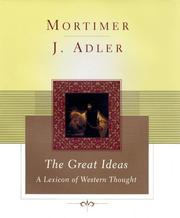
The Great Ideas, Volume 1
The 2-volume "Syntopicon" of Britannica's Great Books of the Western World, providing a survey and a concordance of the Great Ideas treated in the remaining 51 volumes of the set, is itself one of the most important works of the 20th century. One of the …

Great Books of the Western World
Discusses the selection of works for and purpose of the set "Great Books of the Western World" and provides tools for use with the set, including author-to-idea and idea-to-author indexes and a ten-year reading list.
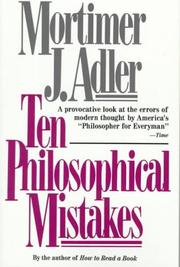
Ten philosophical mistakes
Examines ten errors in modern thought and shows how they have led to serious consequences in our everyday lives. Tells how they came about, how to avoid them, and how to counter their negative effects.
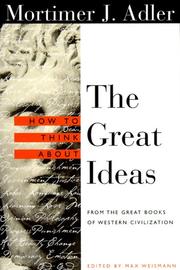
How to think about the great ideas
"It was Adler who first understood that there are a definite number of Great Ideas (102, later increased to 103) which form the core of the thought of Western Civilization and the keys to understanding the Great Books.". "How to Think about the Great Ideas, …


The Great Ideas, Volume 2
A Syntopicon: An Index to The Great Ideas (1952) is a two-volume index, published as volumes 2 and 3 of Encyclopædia Britannica’s collection Great Books of the Western World. Compiled by Mortimer Adler, an American philosopher, under the guidance of Robert Hutchins, president of the …

We Hold These Truths
The ideas Adler examines include those at the core of the Declaration of Independence -- human equality, inalienable human rights, civil rights, the pursuit of happiness, and both the consent and dissent of the governed. These are the ideas that form the basis for the …
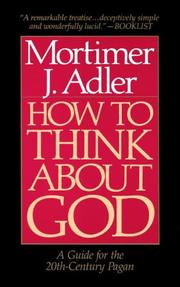
How to think about God
Dr. Adler, in his discussion, extends and modernizes the argument for the existence of God developed by Aristotle and Aquinas. Without relying on faith, mysticism, or science (none of which, according to Dr. Adler, can prove or disprove the existence of God), he uses a …
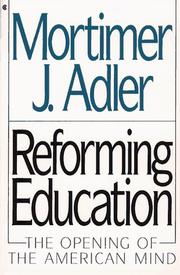
Reforming Education
A founder of the "great books" movement, Adler ( How to Read a Book ) opens this collection of his essays that span a half century with a stinging rebuke to The Closing of the American Mind , Allan Bloom's pessimistic appraisal of today's colleges. …
Intellect
Argues that in the conflict between ancient and modern approaches to the study of the mind key insights have been lost that bear on contemporary psychology. Seeks to restore the intellect to its primary in the understanding of the mind.

Gateway to the great books
Gateway to the Great Books are great writings which selections include short stories, plays, essays, scientific papers, speeches, and letters. Each selection represents a primary, original, and fundamental contribution to ones understanding of the universe and themselves. There are over 135 Authors, 225 Selections and …


The Paideia program
The authors provide here a hands-on guide to teaching, according to Paideia principles and techniques. It is quite thorough and covers all the major disciplines as well as some very specific details. One distinguisinhg bonus is the amazing reading list, capable of enhancing one's IQ …


How to prove there is a God
One Of The Great Tasks of Mortimer Adler's illustrious life was his search for a watertight proof of the existence of God. Adler believed that his search had been successful. How to Prove There Is a God includes a transcript of one of Adler's appearances …
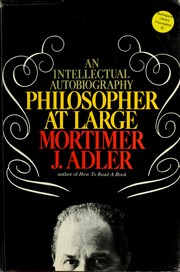


Great treasury of Western thought
On t.p.: A compendium of important statements on man and his institutions by the great thinkers in western history.


A second look in the rear-view mirror
"Fifteen years ago, when I was only seventy-five years old, I wrote my autobiography prematurely ... Much has happened in my life since then ... I am, therefore, impelled to take a second look in the rearview mirror and hope that those who found the …


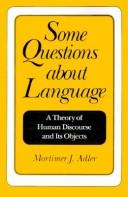
Some questions about language
Mortimer J. Adler's "Some Questions about Language" explores the origins and nature of human discourse, asking how meaningless sounds and marks become meaningful words and what those words refer to. Here's a more detailed breakdown: Core Question: The book delves into the fundamental question of …


The difference of man and the difference it makes
"Based on the [2d ser. of] Encyclopaedia Britannica lectures delivered [by the author] at the University of Chicago, 1966." Bibliographical references included in "Notes" (p. [295]-367) Bibliography: p. 371-387.
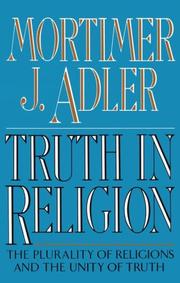
Truth in religion
Only if, with regard to the diversity of religions, there are questions about truth and falsehood do we have a problem about the pluralism of religions and the unity of truth. That problem is not concerned with preserving religious liberty, freedom of worship, and the …


The four dimensions of philosophy
In Greek and Roman antiquity, philosophy was supreme in the domain of learning. Philosophy was the name for the pursuit of truth about the most fundamental things to be known or understood. It was the most desirable of all the goods of the mind. But …


The conditions of philosophy
Is philosophy in its dotage? Is it bankrupt and no longer deserving of the respect that is accorded science? Or is it still in infancy? As major intellectual enterprises in our Western civilization, science and philosophy have had equally long careers, going back to their …


