David Lindley is a British theoretical physicist and author. He holds a B.A. in theoretical physics from Cambridge University (1975–1978) and a PhD in astrophysics from the University of Sussex (1978–1981). Then he was a postdoctoral researcher at Cambridge University. From 1983 to 1986, he was a research fellow in the Theoretical Astrophysics Group at the Fermi National Accelerator Laboratory. He then served as technical editor and writer with the Central Design Group for the Superconducting Supercollider at the Lawrence Berkeley Laboratory in Berkeley, California.
From Wikipedia · CC BY-SA 4.0
10 books in our catalogue.
1996
251 pages
Philosophy & ReligionScience & Nature
Few revolutions in science have been more far-reaching - but less understood - than the quantum revolution in physics. Everyday experience cannot prepare us for the strange phenomena of the subatomic world, where quantum effects become all important. Here, particles can look like waves, and …
2001
272 pages
Biography & MemoirHistoryScience & Nature
"Now writer David Lindley portrays the dramatic story of Boltzmann and his embrace of the atom, while providing a window on the civilized world that gave birth to our scientific era. Boltzmann emerges as an endearingly quixotic character, passionately inspired by Beethoven, who muddled through …
2007
272 pages
Philosophy & ReligionScience & Nature
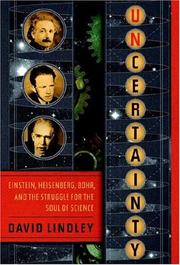
The more precisely the position is determined, the less precisely the momentum is known in this instant, and vice versa.--Werner HeisenbergThat God would choose to play dice with the world is something I cannot believe.--Albert EinsteinNothing exists until it is measured.--Neils BohrThe remarkable story of …
2004
392 pages
Biography & MemoirScience & Nature
1993
288 pages
Philosophy & ReligionScience & Nature
In The End of Physics, Lindley challenged the assumption that string theorists might achieve a unified theory. He contended that particle physics was in danger of becoming a branch of aesthetics, since these theories could be validated only by subjective criteria, such as elegance and …
1997
256 pages
Could it really happen? Could modern scientists using cutting-edge laboratory techniques really clone living, breathing, hungry dinosaurs and populate a true-to-life Jurassic Park? Along with delightful and fascinating facts and factoids - including Jurassic Park and The Lost World movie bloopers - readers will learn:. …
2020
240 pages
HistoryScience & Nature
1998
726 pages
Language & ReferenceScience & Nature