The Club of Queer Trades
1900
131 pages
★ 3.23 · 13
Historical FictionLiterary & ClassicsMystery & Thriller
The Tremendous Adventures of Major Brown.
The Tremendous Adventures of Major Brown.
Series of stories featuring world-weary government employee Horne Fisher and crusading journalist Harold March. Mysteries that are reflections on moral ambiguity in politics in the British Empire on the eve of World War I
A wind sprang high in the west, like a wave of unreasonable happiness, and tore eastward across England, trailing with it the frosty scent of forests and the cold intoxication of the sea. It a million holes and corners it refreshed a man like a …
Four Faultless Felons is a collection of stories by G. K. Chesterton, comprising four mystery novelettes connected by the theme of persons assumed to be criminals, who are paradoxically not so. Published in 1930 in London by Cassell and in New York by Dodd, Mead …
Allegorical fantasy novel about a Catholic and an atheistic socialist who argue passionately with each other. For political reasons, both are forced into an insane asylum.
Can you trust yourself when you don't know who you are? In a park in London, secret policeman Gabriel Syme strikes up a conversation with an anarchist. Sworn to do his duty, Syme uses his new acquaintance to go undercover in Europe's Central Anarchist Council …
A witty and surreal novel of the future. In a rather dull stuck-in-a-rut future, a prankster chosen randomly to be King of England revives the old ways and inadvertently arouses romantic patriotism and civil war between the boroughs of London.
The Poet and the Lunatics: Episodes in the Life of Gabriel Gale is a 1929 work by G. K. Chesterton. It consists of a series of short stories about Gabriel Gale, who is a poet and painter. Every story involves another character who is mad …
Presents a collection of fifteen short stories that feature the exploits of Father Brown, a seemingly doddering priest with a keen ability to solve crimes.
Orthodoxy is G. K. Chesterton’s response to his critics’ assertion that his earlier collection of essays, Heretics, had “merely criticised current philosophies without offering any alternative philosophy.” In his intellectual journey from pagan to agnostic to positivist philosopher, he had attempted to build a philosophy …
The Everlasting Man is inspired by H. G. Wells’ The Outline of History, which explains the history of mankind and religion as solely a product of natural selection and other material causes. In contrast, G. K. Chesterton presents the case for Christianity throughout history, by …
Gilbert Keith Chesterton was born in London, England on the 29th of May, 1874. Though he considered himself a mere rollicking journalist, he was actually a prolific and gifted writer in virtually every area of literature. A man of strong opinions and enormously talented at …
"No two lives are more interesting or more diverse than those of St. Francis of Assisi and St. Thomas Aquinas. The two stand at almost the opposite sides of how to understand and live the same Christian life. The St. Francis book is especially significant …
I originally called this book "What is Wrong," and it would have satisfied your sardonic temper to note the number of social misunderstandings that arose from the use of the title. Many a mild lady visitor opened her eyes when I remarked casually, I have …
Quoting the foreword to the 1942 Readers Club edition by Alexander Woollcott: “This happiest work by the late Gilbert Keith Chesterton, God rest his soul, is as luminous and infectious a book as ever one author wrote about another.” [Chesterton died in 1936-ed. note.] Woollcott …
É na saga do Padre Brown que Chesterton atinge o cume da beleza artística como se verá por este A Inocência do Padre Brown reunião de doze contos admiráveis e impecáveis, entre os quais, todavia, ouso destacar muito especialmente A Cruz Azul e O Martelo …
G.K. Chesterton lends his witty, astute and sardonic prose to the much loved figure of Saint Francis of Assis. Grounding the man behind the myth he states "however wild and romantic his gyrations might appear to many, [Francis] always hung on to reason by one …
"And the young woman of the house," asked Dr. Hood, with huge and silent amusement, "what does she want?" "Why, she wants to marry him," cried Father Brown, sitting up eagerly. "That is just the awful complication." "It is indeed a hideous enigma," said Dr. …
" St. Thomas Aquinas is enriched by the author's unique ability to see the world through the saint's eyes, a fresh and animated view that shows us Aquinas as no other biography has. Acclaimed as the best book ever written on Aquinas by such outstanding …
Covering topics ranging from literature to philosophy, history to social criticism, this is a snapshot of thought on 20th-century Europe (and the world) by one of Europe's sharpest wits and ablest pens. With chapter titles ranging from “The Miser and His Friends” to “The Red …
Annotated anthology textbook of detective stories for American high schools, containing literary history and criticism with student exercises designed to deepen similar literary sensibilities. Contains: Edgar Allan Poe The murders in the Rue Morgue -- The purloined letter -- The gold bug -- Arthur Conan …
Contains: Adventure of the Abbey Grange / Sir Arthur Conan Doyle A marriage tragedy / Wilkie Collins Lord Chizelrigg's missing fortune / Robert Barr The Fordwych Castle mystery / Emmuska, Baroness Orczy The blue scarab / R. Austin Freeman The doom of the Darnaways / …
The case of the perfect maid / Agatha Christie Never shake a family tree / Donald E. Westlake The man who explained miracles / Carter Dickson (John Dickson Carr) Mom knows best / James Yaffe A bad influence / Hugh Pentecost His last bow / …
"Most people either say that they agree with Bernard Shaw or that they do not understand him. I am the only person who understands him, and I do not agree with him." -- G. K. C.
A collection of stories and poems, arranged in four sections corresponding to the four seasons. A Crazy tale / Gilbert Keith Chesterton How the rhinoceros got his skin / Rudyard Kipling Reflections / Lafcadio Hearn Complements / Emile Zola The King of the Golden River …
Of great limbs gone to chaos, A great face turned to night - Why bend above a shapeless shroud Seeking in such archaic cloud Sight of strong lords and light?
Like many of Chesterton's works, The Flying Inn is a humorous, satirical romp that conceals beneath a playful exterior important and thoughtful philosophical insights on religion, the nature of the state, political oversight and authority, and the roots of human liberty. The rollicking story follows …
Father Brown, an unassuming and shabbily dressed priest, possesses an incredible ability to solve crimes and murders. Here he reveals the secret of his success. He discovers the culprit by imagining himself to be inside the mind of the criminal. This fourth collection of Father …
Chesterton's survey of English history, including: "The Province of Britain," "The Age of Legends," "The Defeat of the Barbarians," "St. Edward and the Norman Kings," "The Age of the Crusades," "The Problem of the Plantagenets," "The Meaning of Merry England," "Nationality and the French Wars," …
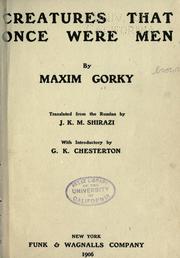
The Boni and Liveright edition of 1918 introduced by G.K. Chesterton and translated by J.M. Shirazi contains five stories - 'Creatures that once were men', 'Twenty-six men and a Girl', 'Chelkash', 'My Fellow Traveller', and 'On a Raft'.
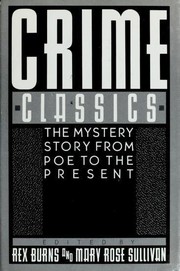
With its high stakes and uncertain outcome, the mystery tale is the most popular form of fiction in the United States. Crime Classics presents spellbinding works by such masters as Edgar Allan Poe, Arthur Conan Doyle, Dashiell Hammett, Dorothy Sayers, and Agatha Christie, as well …
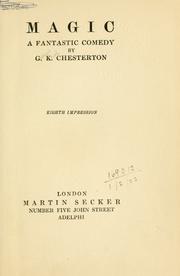
Is magic real? That's the theme of this delightful play from the popular writer, G. K. Chesterton. First performed in 1913, it was so successful that it ran for over a hundred nights.
Ozymandias / Percy Bysshe Shelley The destruction of Sennacherib / George Gordon Byron The vision of Belshazzar / George Gordon Byron Alexander's feast / John Dryden Antony to Cleopatra / William Haines Lytle The angels' song / Edmund Hamilton Sears Boadicea / William Cowper The …
Avec l'humour qui lui est propre, Chesterton (1874-1936) traite dans les Crimes de l'Angleterre de l'histoire anglaise et européenne sur un plan philosophique et critique. Si le romancier comme le moraliste sont bien connus, c'est ici un Chesterton doté d'une véritable vision géopolitique qu'il nous …
A Shilling for My Thoughts," edited by E. V. Lucas, is a collection of essays, stories, and other writings by G.K. Chesterton, offering a diverse selection of his famous thought-provoking and often paradoxical perspectives on a wide range of topics, from philosophy and religion to …
Contains: The bamboo trap by Robert S. Lemmon Leiningen versus the ants by Carl Stephenson The blue cross by G.K. Chesterton The most dangerous game by Richard Connell The fourth man by John Russell The interlopers by "Saki" (H.H. Munro) The adventure of the dancing …
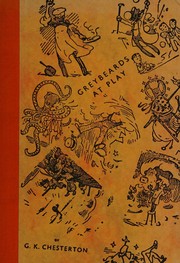
"Greybeards at Play" by G.K. Chesterton is a collection of whimsical rhymes and sketches published in the early 20th century, offering reflections on life, nature, and the childhood from the perspective of aging gentlemen. The book is a collection of short humorous poetry and sketches. …
G.K. Chesterton was a consummately witty man. The author draws on Chesterton's most humorous epigrams and more serious extracts not only from his most popular works, the 'Father Brown' stories, but his contributions to the 'Illustrated London News', 'GK's Weekly' and his numerous novels, poetry, …
This volume contains a collection of essays written by G. K. Chesterton. These essays were originally published in the 'Daily News', and cover a range of topics ranging from Gargoyles to strolls around Marble Arch. The essays contained herein include: The Surrender of a Cockney, …
The author argues that marriage is a patriotic duty and that divorce is a threat to democracy.
Hilaire Belloc called "Lepanto" Chesterton's greatest poem and the greatest poem of his generation. But not only have English classes neglected this masterpiece of rhyme and meter, History classes have neglected the story of the pivotal battle upon which the poem is based. This book …
Critic, author, and debunker extraordinaire, G. K. Chesterton (1874-1936) delighted in probing the ambiguities of Christian theology. A number of his most successful attempts at combining first-rate fiction with acute social observation appear in this original selection from his best detective stories featuring the priest-sleuth …
Book digitized by Google from the library of the University of Michigan and uploaded to the Internet Archive by user tpb.
Book digitized by Google from the library of the University of Michigan and uploaded to the Internet Archive by user tpb.
When the long grey lines came flooding upon Paris in the plain, We stood and drank of the last free air we never could taste again: They had led us back from the lost battle, to halt we knew not where and stilled us; and …
Discusses the distribution of property under the present economic system.
The purloined letter / by Edgar Allan Poe -- Hunted down / by Charles Dickens -- Silver blaze / by Arthur Conan Doyle ; -- The blue cross / by G.K. Chesterton -- The second bullet / by Anna Katherine Green -- Naboth's vineyard / …
A G. K. Chesterton con frecuencia se le llamó «Príncipe de las paradojas», así que empecemos por esta: nos hallamos ante una obra que es vieja como ella sola. Pero que no podría ser más contemporánea. En esta antología de ensayos, escritos en otro siglo …
The first one-volume reader of the best of G.K. Chesterton's writing in the full range of genres he mastered. Chesterton was a towering literary figure of the early twentieth century, accomplished and prolific in many literary forms. A forceful proponent of Christianity and a critic …
The Paradoxes of Mr. Pond is G. K. Chesterton's final collection of detective stories, published after his death in 1936. Of the eight mysteries, seven were first printed in the Storyteller magazine. The Unmentionable Man was unique to the book.