The Projective Cast
- Pages
- 432
- 2 editions
- First published
- 1995
- 1 language
Join or log in to shelve and rate Free, no password.
Overview
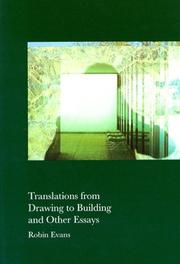
In this long-awaited book, completed shortly before his death, Evans recasts the idea of the relationship between geometry and architecture, drawing on mathematics, engineering, art history, and aesthetics to uncover processes in the imagining and realizing of architectural form. He shows that geometry does not always play a stolid and dormant role but, in fact, may be an active agent in the links between thinking and imagination, imagination and drawing, drawing and building.
He suggests a theory of architecture that is based on the many transactions between architecture and geometry as evidenced in individual buildings, largely in Europe, from the fifteenth to the twentieth century.
From the Henry VII Chapel at Westminster Abbey to Le Corbusier's Ronchamp, from Raphael's Sant'Eligio and the work of Piero della Francesca and Philibert Delorme to Guarino Guarini and the painters of cubism, Evans explores the geometries involved, asking whether they are in fact the stable underpinnings of the creative, intuitive, or rhetorical aspects of architecture.
In particular he concentrates on the history of architectural projection, the geometry of vision that has become an internalized and pervasive pictorial method of construction and that, until now, has played only a small part in the development of architectural theory.
Ratings & reviews
Log in to rate or review this book.
No written reviews yet.
Discussions
Talk about this book with other readers.
Log in to start a discussion.
No discussions yet.
Editions


Details & links
- First published
- 1995
- Pages
- 432
- Languages
- Available in 1 language
Where to buy this book: see “Buy this book”
More about this book
Read a sample, borrow it or see other editions → openlibrary.org