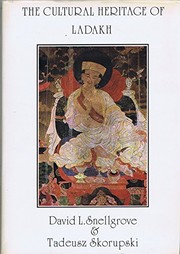
A cultural history of Tibet
- Pages
- 308
- 7 editions
- First published
- 1968
- 1 language
Join or log in to shelve and rate Free, no password.
Overview
“The civilization of the Tibetan people is disappearing before our very eyes, and apart from a few gentle protests here and there, the rest of the world lets it go without comment and without regret. Many civilizations have declined and disintegrated in the past, but it is rare that one has the opportunity of being an informed witness of such events.” So write David Snellgrove and Hugh Richardson, the authors of this comprehensive survey of a rapidly vanishing civilization, in which they trace the evolution of Tibetan culture from its sixth-century pre-Buddhist origins through the introduction of Buddhism, the rise of the great monastic houses, the rise of the “Yellow Hats,” and the establishment of the Dalai Lama to Tibet’s fall to the Chinese Communists in 1959. Because a wealth of new material—most of it previously unfamiliar to the West—has become available since the exile of many Tibetan scholars, it is now possible, as never before, to analyze the richness of this Central Asian civilization and to trace what it assimilated from earlier cultures, particularly from China and India. In their discussion of the three major periods of Tibetan history, the authors draw parallels with the structure of life in England and Western Europe. The strong analogies break down with the European Renaissance, a cultural development that Tibet, of course, did not experience. A final section focuses on Tibet’s belated emergence into modern times, ending with its subjugation by the Chinese Communists. Subjects that are discussed in considerable detail include the geography of Tibet, the origins of its people, and its agriculture, religion, architecture, secular literature, philosophy, arts and crafts, music, dance, early historical records, monarchic rule, and recent political developments. The text is handsomely illustrated with more than one hundred previously unpublished photographs of rarely seen material. It contains, in addition, a chronological table, notes on Tibetan pronunciation, a chart of monastic orders, and two maps.” BOOK JACKET
Ratings & reviews
Log in to rate or review this book.
No written reviews yet.
Discussions
Talk about this book with other readers.
Log in to start a discussion.
No discussions yet.
Editions


Details & links
- First published
- 1968
- Pages
- 308
- Languages
- Available in 1 language
Where to buy this book: see “Buy this book”
More about this book
Read a sample, borrow it or see other editions → openlibrary.org