Business & EconomicsPolitics & Society
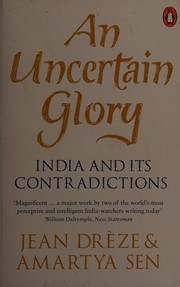
An Uncertain Glory
- Pages
- 445
- 5 editions
- First published
- 2013
- 1 language
Join or log in to shelve and rate Free, no password.
Overview
Two of India's leading economists argue that, despite economic development, there must be a greater understanding of inequalities in India. - When India became independent in 1947 after two centuries of colonial subjugation, it immediately - and quite successfully - adopted a firmly democratic political system, with multiple parties, freedom of speech and extensive political rights. The famines that had been so common in colonial days disappeared, and steady economic growth replaced the almost complete stagnation characteristic of the long rule of the Raj. The growth of the Indian economy, which quickened over the last three decades, became the second fastest in the world. Despite a recent dip, it is still one of the highest among nations.
Maintaining rapid as well as environmentally sustainable growth remains an important and achieveable goal for India. In An Uncertain Glory, two of India's leading economists argue that the country's main problems lie elsewhere, particularly in the lack of attention paid to the essential needs of the people, especially the poor. The deep inequalities in Indian society tend to constrict public discussion in India's vibrant media to the lives and concerns of the relatively affluent.One of the biggest failures has been the very inadequate use of the public resources generated by economic growth to expand India's lagging physical and social infrastructure (in sharp contrast, for example, to what China has done): there is a continued inadequacy both of social services such as schooling, medical care and immunization, and of physical services such as the provision of safe water, electricity, drainage and sanitation. Even as India has overtaken a large number of other countries in the rate of economic growth, it has, because of these inadequacies, fallen behind many of the same countries - often very poor ones - in the progress of quality of life.
Because of the importance of democracy in India, addressing these failures will require not only significant policy rethinking by the government, but also a better public understanding of the abysmal extent of these social and economic deprivations. This book makes a powerful contribution to that understanding.
Ratings & reviews
Log in to rate or review this book.
No written reviews yet.
Discussions
Talk about this book with other readers.
Log in to start a discussion.
No discussions yet.
Editions


Details & links
- First published
- 2013
- Pages
- 445
- Languages
- Available in 1 language
Where to buy this book: see “Buy this book”
More about this book
Read a sample, borrow it or see other editions → openlibrary.org