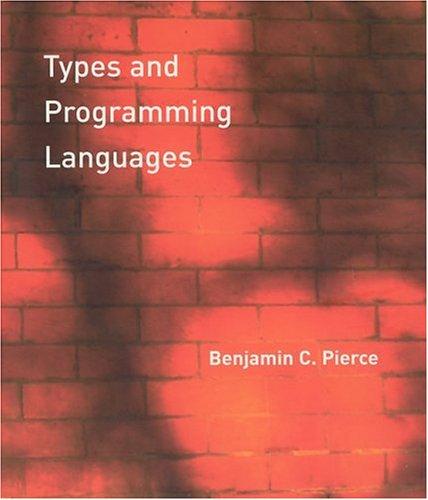
Types and Programming Languages
- Pages
- 645
- 1 edition
- First published
- 2002
- 1 language
Join or log in to shelve and rate Free, no password.
Overview
A type system is a syntactic method for automatically checking the absence of certain erroneous behaviors by classifying program phrases according to the kinds of values they compute. The study of type systems--and of programming languages from a type-theoretic perspective -- -has important applications in software engineering, language design, high-performance compilers, and security. This text provides a comprehensive introduction both to type systems in computer science and to the basic theory of programming languages. The approach is pragmatic and operational; each new concept is motivated by programming examples and the more theoretical sections are driven by the needs of implementations. Each chapter is accompanied by numerous exercises and solutions, as well as a running implementation, available via the Web. Dependencies between chapters are explicitly identified, allowing readers to choose a variety of paths through the material. The core topics include the untyped lambda-calculus, simple type systems, type reconstruction, universal and existential polymorphism, subtyping, bounded quantification, recursive types, kinds, and type operators. Extended case studies develop a variety of approaches to modeling the features of object-oriented languages.
Ratings & reviews
Log in to rate or review this book.
No written reviews yet.
Discussions
Talk about this book with other readers.
Log in to start a discussion.
No discussions yet.
Editions

Details & links
- First published
- 2002
- Pages
- 645
- Series
- Types and Programming Languages (book 1)
- Languages
- Available in 1 language
Where to buy this book: see “Buy this book”
More about this book
Read a sample, borrow it or see other editions → openlibrary.org