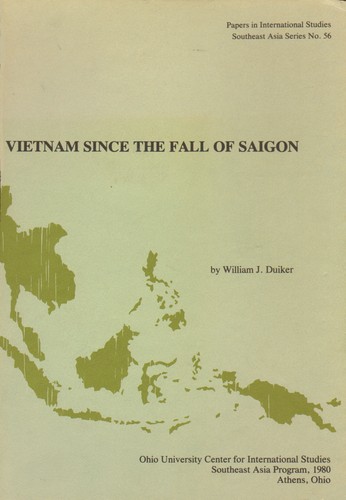
Vietnam since the fall of Saigon
- Pages
- 261
- 3 editions
- First published
- 1980
- 1 language
Join or log in to shelve and rate Free, no password.
Overview
When North Vietnamese troops occupied Saigon at the end of April 1975, their leaders in Hanoi faced the future with pride and confidence. Almost fifteen years later, the euphoria has given way to sober realism. Since the end of the war, the Communist regime has faced an almost uninterrupted series of difficulties including sluggish economic growth at home and a costly occupation of neighboring Cambodia. For the Vietnamese, the basic documents came from Lenin and Mao Tse-tung. The first task of the new rulers in South Vietnam was to fill the vacuum left by the virtual disintegration of the previous regime. Beyond the immediate problem of restoring law and order in the South, the primary problem for the new regime would be to set the economic sector back on its feet. The new regime also moved expeditiously to eliminate or at least reduce the "poisonous weeds" of Western bourgeois culture and plant the seeds of a new and beautiful socialist culture. The regime was taking the first tentative steps toward building socialism in the South while for the time being tolerating a significant degree of private enterprise in most sectors of the economy. - Publisher.
Ratings & reviews
Log in to rate or review this book.
No written reviews yet.
Discussions
Talk about this book with other readers.
Log in to start a discussion.
No discussions yet.
Editions
-
Format not known Ohio University Center for International Studies 1989 383 pages English ISBN 9780896801622 Open Library
-
Format not known Ohio University Center for International Studies, Center for Southeast Asian Studies 1985 261 pages English ISBN 9780896801332 Open Library
-
Paperback Ohio University, Center for International Studies 1980 77 pages English ISBN 9780896801066 Open Library


Details & links
- First published
- 1980
- Pages
- 261
- Languages
- Available in 1 language
Where to buy this book: see “Buy this book”
More about this book
Read a sample, borrow it or see other editions → openlibrary.org