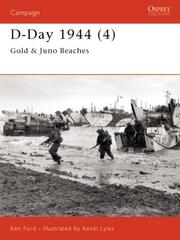
D-Day 1944 (3)
- Pages
- 96
- 6 editions
- First published
- 2002
- 1 language
Join or log in to shelve and rate Free, no password.
Overview
"At 1600 hrs on June 6, 1944, a Horsa glider ground to a halt a mere 60 yards from the Orne Canal bridge at Benouville in Normandy. A small group of British paratroopers burst from it and stormed the bridge within minutes. The Allied liberation of Nazi-occupied Europe had begun. Within a few hours, landing craft would swarm towards Ouistreham as British 3rd Division stormed ashore at Sword Beach. The battle would then begin to break through to relieve the paratroopers. Ken Ford details the assault by British 6th Airborne Division and the British landings on Sword Beach that secured the vital left flank of the invasion. On the eastern most flank of the Allied landings in Normandy was Sword Beach, the responsibility of British 3rd Division. Their objectives for D-Day were to seize Ouistreham and Lion-sur-Mer, and to drive inland taking Hermanville, Perriers Ridge, and in co-operation with the Canadians landing on Juno, capture their ultimate goal: the town of Caen.
In addition, they were to link up with the British Airborne forces who were to secure the eastern flank of the beachhead. The leading waves landed at 7: 30 a.m. and managed to get off the beach without heavy German resistance. By mid-morning, Hermanville had been captured but severe congestion on the beach was delaying those troops supposed to be exploiting the landing inland. This allowed the defending German forces, particularly the 21st Panzer Division, valuable time to react to the landings. Stiff German resistance and counter-attacks prevented Caen being taken on the first day and much blood would be shed before it finally fell. 1st Special Service Brigade landed in the Ouistreham area and moved inland to link up with the british Airborne forces. These had been assigned the tasks of securing the area west of the River Dives, destroying a number of bridges over the river and in particular capturing the bridges over the Orne River and the Caen-Ouistreham canal.
First to land were the glider-borne infantry of the Oxfordshire and Buckinghamshire Light infantry commanded by Major John Howard. They successfully seized the canal bridge at Benouville, which has been known since as Pegasus Bridge. The other landings were plagued by high winds with some paratroopers drowning in the river Dives, but five vital bridges were destroyed and in one of the most heroic actions of the landings the Merville battery was stormed and put out of action" -- provided by publisher.
Ratings & reviews
Log in to rate or review this book.
No written reviews yet.
Discussions
Talk about this book with other readers.
Log in to start a discussion.
No discussions yet.
Editions


Details & links
- First published
- 2002
- Pages
- 96
- Languages
- Available in 1 language
Where to buy this book: see “Buy this book”
More about this book
Read a sample, borrow it or see other editions → openlibrary.org