African history
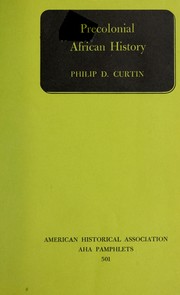
- Pages
- 55
- 10 editions
- First published
- 1963
- 1 language
Join or log in to shelve and rate Free, no password.
Overview
The main aim of the book is to explain how the societies on the African continent came to be as they are today; but the authors also use African history to explore more general questions of how human societies change through time. Their approach and concerns are strongly influenced by the work of anthropologists as well as historians. The book starts with a study of the roots of African culture in the late Stone Age and its aftermath. Thirteen chronologically-arranged regional chapters follow. These divide Africa into four major areas and provide parallel accounts of each across broad historical spans breaking, roughly, at 1500, 1780 and 1880. They take the reader from the first African civilization which grew up along the Nile Valley in ancient Egypt through to the colonial period of modern times. The final section of the book (c.1880 to c.1960) is written on a continent-wide rather than a regional basis. Its six chapters explore the impact of Europe on Africa, and include discussions of the colonial economy; social change in the colonial period; and the clash of cultures and what it has meant for African religion, education and thought. It closes with a review of African resistance to colonial rule, and the end of the European empires.
Ratings & reviews
Log in to rate or review this book.
No written reviews yet.
Discussions
Talk about this book with other readers.
Log in to start a discussion.
No discussions yet.
Editions


Details & links
- First published
- 1963
- Pages
- 55
- Languages
- Available in 1 language
Where to buy this book: see “Buy this book”
More about this book
Read a sample, borrow it or see other editions → openlibrary.org