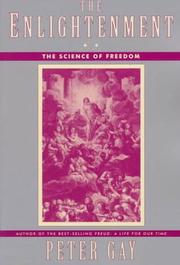
The Enlightenment: an interpretation
- Pages
- 429
- 30 editions
- First published
- 1966
- 2 languages
Join or log in to shelve and rate Free, no password.
Overview
Peter Gay will inevitably leave his stamp on our conception of the Enlight- ment for decades to come. The sheer bulk of his writing on the subject alone will ensure that. He began his re-interpretation of the movement in 1959 with Voltaire's Politics: the Poet as Realist, showing the foremost philosophe to have been a much more liberal and practical political thinker than had often been assumed. There followed in 1964 The Party of Humanity, a series of essays in which Gay challenged some of the commonplace characterizations of the philosophes, especially the notion that they were impractical idealists. Then in 1966 he published The Rise of Modern Paganism, the first volume of his interpretation of the Enlightenment. He completed this analysis in 1969 with a second tome entitled The Science of Freedom. Finally last year he capped his work with The Bridge of Criticism, a debate among Lucian, Eras- mus, and Voltaire which the author admits amounts to a polemic on behalf of the Enlightenment. Meanwhile he had propagated his view of the movement in the introductions to his translations of Voltaire's Philosophical Dictionary and Candide, his anthologies of the works of Deists and of Locke on educa- tion, and his numerous articles and public lecture. -- Description from http://www.jstor.org/stable/2737948 (April 17, 2012).
Ratings & reviews
Log in to rate or review this book.
No written reviews yet.
Discussions
Talk about this book with other readers.
Log in to start a discussion.
No discussions yet.
Editions


Details & links
- First published
- 1966
- Pages
- 429
- Languages
- Available in 2 languages
Where to buy this book: see “Buy this book”
More about this book
Read a sample, borrow it or see other editions → openlibrary.org