Politics & SocietyPsychology & Self-Help
Survival of the Friendliest
- Pages
- 304
- 4 editions
- First published
- 2020
- 1 language
Join or log in to shelve and rate Free, no password.
Overview
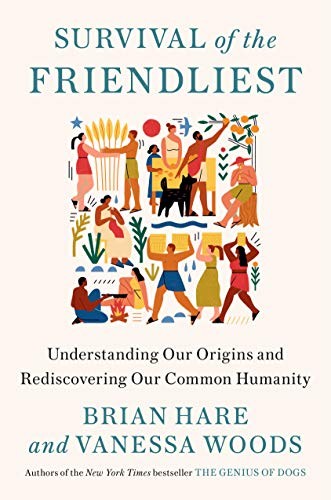
"For most of the approximately 200,000 years that our species has existed, we shared the planet with at least four other types of humans. They were smart, they were strong, and they were inventive. Neanderthals even had the capacity for spoken language. But, one by one, our hominid relatives went extinct. Why did we thrive? In delightfully conversational prose and based on years of his own original research, Brian Hare, professor in the department of evolutionary anthropology and the Center for Cognitive Neuroscience at Duke University, and his wife Vanessa Woods, a research scientist and award-winning journalist, offer a powerful, elegant new theory called "self-domestication" which suggests that we have succeeded not because we were the smartest or strongest but because we are the friendliest. This explanation flies in the face of conventional wisdom. Since Charles Darwin wrote about "evolutionary fitness," scientists have confused fitness with strength, tactical brilliance, and aggression. But what helped us innovate where other primates did not is our knack for coordinating with and listening to others. We can find common cause and identity with both neighbors and strangers if we see them as "one of us." This ability makes us geniuses at cooperation and innovation and is responsible for all the glories of culture and technology in human history. But this gift for friendliness comes at cost. If we perceive that someone is not "one of us," we are capable of unplugging them from our mental network. Where there would have been empathy and compassion, there is nothing, making us both the most tolerant and the most merciless species on the planet. To counteract the rise of tribalism in all aspects of modern life, Hare and Woods argue, we need to expand our empathy and friendliness to include people who aren't obviously like ourselves. need to expand our empathy and friendliness to include people who aren't obviously like ourselves. Brian Hare's groundbreaking research was developed in close collaboration with Richard Wrangham and Michael Tomasello, giants in the field of cognitive evolution. Survival of the Friendliest explains both our evolutionary success and our potential for cruelty in one stroke and sheds new light onto everything from genocide and structural inequality to art and innovation"--
Ratings & reviews
Log in to rate or review this book.
No written reviews yet.
Discussions
Talk about this book with other readers.
Log in to start a discussion.
No discussions yet.
Editions
-
Format not known Random House Publishing Group 2021 304 pages English ISBN 9780399590689 Open Library


Details & links
- First published
- 2020
- Pages
- 304
- Languages
- Available in 1 language
Where to buy this book: see “Buy this book”
More about this book
Read a sample, borrow it or see other editions → openlibrary.org