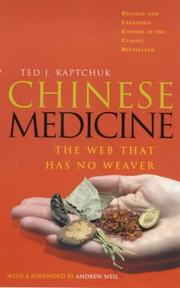
The Web That Has No Weaver
- Pages
- 402
- 5 editions
- First published
- 1983
- 1 language
Join or log in to shelve and rate Free, no password.
Overview
While Western doctors look for disease mechanisms which are the same form person to person, Chinese doctors look for overall patterns of disharmony which are unique to each individual. Ted Kaptchuk, who studied medicine in China, originally intended to translate Chinese medical texts into English, but quickly realized that it would take more than simple translation to convey the meaning of a diagnosis like "damp heat affecting the spleen." Instead, in The Web That Has No Weaver, he explains the theory and philosophy of Chinese medicine, as well as methods of diagnosis and treatment in terms that can be understood by a Western reader. The Chinese emphasis on interconnectedness nad change takes on a very specific character in the context of medicine. When the Chinese physician examines a patient, he or she plans to look at many signs and symptoms and to make of them a diagnosis, to see in them a pattern. Each sign means nothing by itself and acquires meaning only in its relationship to the patient's other signs.
Ratings & reviews
Log in to rate or review this book.
No written reviews yet.
Discussions
Talk about this book with other readers.
Log in to start a discussion.
No discussions yet.
Editions


Details & links
- First published
- 1983
- Pages
- 402
- Languages
- Available in 1 language
Where to buy this book: see “Buy this book”
More about this book
Read a sample, borrow it or see other editions → openlibrary.org