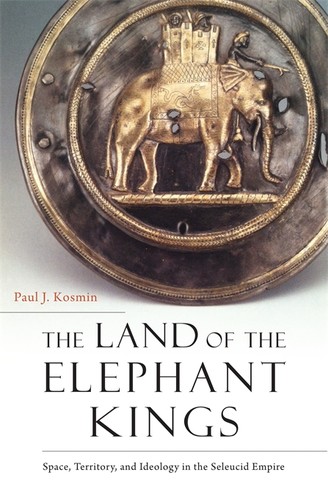
The Land of the Elephant Kings
- Pages
- 448
- 3 editions
- First published
- 2014
- 1 language
Join or log in to shelve and rate Free, no password.
Overview
The Seleucid Empire (311-64 BCE) was unlike anything the ancient Mediterranean and Near Eastern worlds had seen. Stretching from present-day Bulgaria to Tajikistan -- the bulk of Alexander the Great's Asian conquests -- the kingdom encompassed a territory of remarkable ethnic, religious, and linguistic diversity; yet it did not include Macedonia, the ancestral homeland of the dynasty. The Land of the Elephant Kings investigates how the Seleucid kings, ruling over lands to which they had no historic claim, attempted to transform this territory into a coherent and meaningful space. Based on recent archaeological evidence and ancient primary sources, Paul J. Kosmin's multidisciplinary approach treats the Seleucid Empire not as a mosaic of regions but as a land unified in imperial ideology and articulated by spatial practices. Kosmin uncovers how Seleucid geographers and ethnographers worked to naturalize the kingdom's borders with India and Central Asia in ways that shaped Roman and later medieval understandings of "the East." In the West, Seleucid rulers turned their backs on Macedonia, shifting their sense of homeland to Syria. By mapping the Seleucid kings' travels and studying the cities they founded -- an ambitious colonial policy that has influenced the Near East to this day -- Kosmin shows how the empire's territorial identity was constructed on the ground. In the empire's final century, with enemies pressing harder and central power disintegrating, we see that the very modes by which Seleucid territory had been formed determined the way in which it fell apart. - Publisher.
Ratings & reviews
Log in to rate or review this book.
No written reviews yet.
Discussions
Talk about this book with other readers.
Log in to start a discussion.
No discussions yet.
Editions


Details & links
- First published
- 2014
- Pages
- 448
- Languages
- Available in 1 language
Where to buy this book: see “Buy this book”
More about this book
Read a sample, borrow it or see other editions → openlibrary.org