Language & ReferencePsychology & Self-Help
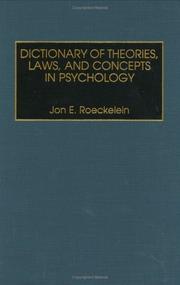
Elsevier's dictionary of psychological theories
- Pages
- 679
- 1 edition
- First published
- 2006
- 1 language
Join or log in to shelve and rate Free, no password.
Overview
"In attempting to understand and explain various behaviour, events, and phenomena in their field, psychologists have developed and enunciated an enormous number of 'best guesses' or theories concerning the phenomenon in question. Such theories involve speculations and statements that range on a potency continuum from 'strong' to 'weak'. The term theory, itself, has been conceived of in various ways in the psychological literature. In the present dictionary, the strategy of lumping together all the various traditional descriptive labels regarding psychologists ?best guesses? under the single descriptive term theory has been adopted. The descriptive labels of principle, law, theory, model, paradigm, effect, hypothesis and doctrine are attached to many of the entries, and all such descriptive labels are subsumed under the umbrella term theory.
The title of this dictionary emphasizes the term theory (implying both strong and weak best guesses) and is a way of indication, overall, the contents of this comprehensive dictionary in a parsimonious and felicitous fashion. The dictionary will contain approximately 2,000 terms covering the origination, development, and evolution of various psychological concepts, as well as the historical definition, analysis, and criticisms of psychological concepts. Terms and definitions are in English." -- Publisher's website.
Ratings & reviews
Log in to rate or review this book.
No written reviews yet.
Discussions
Talk about this book with other readers.
Log in to start a discussion.
No discussions yet.
Editions

Details & links
- First published
- 2006
- Pages
- 679
- Languages
- Available in 1 language
Where to buy this book: see “Buy this book”
More about this book
Read a sample, borrow it or see other editions → openlibrary.org