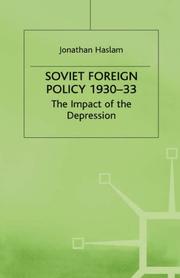
The Soviet Union and the threat from the East, 1933-41
- Pages
- 208
- 2 editions
- First published
- 1992
- 1 language
Join or log in to shelve and rate Free, no password.
Overview
In the 1930s the Soviet Union was an Asian as well as a European power. The expansion of militaristic Japan into Manchuria in 1931 brough to Soviet borders a series new threat that complicated Stalin's response to the challenge emerging from Nazi Germany after 1933. Whereas in Europe, at least until 1939, the hope of a collective security system to contain Germany drew Moscow closer to the democracies, in Asia any such hope was soon extinguished by U.S. isolationism and the over-extension of British and French military power. The net result was the massive reinforcement of Soviet military capabilities in the Far East, unfortunately accompanied not merely by the mobilisation of Communist parties in the region as adjuncts of Soviet power, but also by the naked resurgence of Russian imperial ambitions. While the military expansion served its defensive purpose in deterring Japan, the concomitant revival of Tsarist claims and the extension of Communist activism had serious implications for the future security of the region in the postwar world. -- from dust jacket.
Ratings & reviews
Log in to rate or review this book.
No written reviews yet.
Discussions
Talk about this book with other readers.
Log in to start a discussion.
No discussions yet.
Editions
-
Format not known University of Pittsburgh Press 1992 208 pages English ISBN 9780822911678 Open Library
-
Format not known Macmillan in association with the Centre for Russian and East European Studies, University of Birmingham 1992 208 pages English ISBN 9780333300510 Open Library

Details & links
- First published
- 1992
- Pages
- 208
- Languages
- Available in 1 language
Where to buy this book: see “Buy this book”
More about this book
Read a sample, borrow it or see other editions → openlibrary.org