Performance measurement, evaluation, and incentives
- Pages
- 310
- 1 edition
- First published
- 1992
- 1 language
Join or log in to shelve and rate Free, no password.
Overview
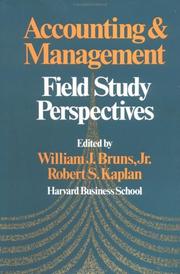
The ability to measure and reward the performance of managers and business units is critical to organizations of all kinds. There is scanty academic literature, however, about how these systems actually function in companies today. To address these issues, a colloquium was held at the Harvard Business School in June 1990 to discuss the results of field research conducted by a group of academics working in these areas. Performance Measurement, Evaluation, and Incentives.
Presents their findings. These field studies will greatly enrich both managers' and academics' understanding of the problems managers encounter as they attempt to measure and evaluate performance. In Part I, contributors discuss procedures and systems for evaluating performance and providing incentives. Bruns and McKinnon look at one effect of performance evaluation schemes in twelve corporations in the United States and Canada; Murphy analyzes the much-admired Merck.
Performance Appraisal Program as it evolved since its inception in 1978; Merchant and Riccaboni look at the implementation of incentive compensation by the Fiat Group in Italy; Otley concentrates on the introduction of incentive compensation to the branch network major British bank; Baker and Wruck discuss change in incentives that were introduced after a leveraged buyout; and Bento and Ferreira appraise the importance of organizational culture to evaluation and.
Incentive schemes. Part II focuses on issues that arise from the ways in which work is organized. Lazear considers the provocative question of "what is a job?" in his study of data from one firm over a 13-year period; Mohrman, Mohrman, and Lawler present a contrasting view in their study of three organizations that redesigned systems for group performance. These two papers provide a comprehensive summary of issues that are of particular interest today as companies.
Reorganize, downsize, and restructure work to make better use of new technologies or adapt to changing conditions. Part III reports on special problems that complicate attempts to measure performance. Euske looks at some issues involved in defining control mechanisms and performance measures in profit and nonprofit institutions with objectives that are not well defined. Verma examines total-factor productivity measurement at Ethyl Corporation and its usefulness to.
Management. Unlike academic models, these field studies vividly reveal the complex cultural and organizational environments in which performance measurements are made and evaluated. The observations and conclusions not only describe how organizations are coping with these difficult issues today, but also add to a research agenda that may enable theory and practice to come together to improve organizational and individual performance, and to make more effective use of.
Incentives.
Ratings & reviews
Log in to rate or review this book.
No written reviews yet.
Discussions
Talk about this book with other readers.
Log in to start a discussion.
No discussions yet.
Editions
-
Format not known Harvard Business School Press 1992 310 pages English ISBN 9780875843506 Open Library

Details & links
- First published
- 1992
- Pages
- 310
- Languages
- Available in 1 language
Where to buy this book: see “Buy this book”
More about this book
Read a sample, borrow it or see other editions → openlibrary.org