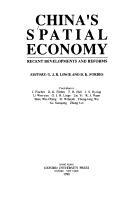
China's new spatial economy
- Pages
- 233
- 1 edition
- First published
- 1997
- 1 language
Join or log in to shelve and rate Free, no password.
Overview
The spatial economy of China should not be seen as a single entity. In reality, as this book demonstrates, it consists of a series of increasingly diverse regions. Although these are becoming more closely linked in terms of transport and communications, each has a distinct development agenda and longer-term potential. This book analyses and illustrates the growing differences between and within the ageing north-east; the sedate region around Beijing and Tianjin; the thrusting municipality of Shanghai; the emerging Changjiang (Yangtze) Delta and Valley; the adolescent south-east; and the inchoate inland. Sweeping claims have been made about the continuing rapid economic progress of China, but it is probable that the pace of growth will be slowed by the complex and interrelated problems which the country faces. These include the burden of inefficient state enterprises, unemployment, inadequate infrastructure, the ageing population, pollution, and the growing shortages of water and energy. The authors show how these problems are affecting the various parts of China in different ways, thus adding yet another dynamic to the country's future spatial organization.
Ratings & reviews
Log in to rate or review this book.
No written reviews yet.
Discussions
Talk about this book with other readers.
Log in to start a discussion.
No discussions yet.
Editions

Details & links
- First published
- 1997
- Pages
- 233
- Languages
- Available in 1 language
Where to buy this book: see “Buy this book”
More about this book
Read a sample, borrow it or see other editions → openlibrary.org