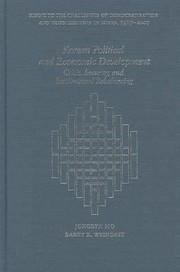
Shaping a new economic relationship
- Pages
- 202
- 2 editions
- First published
- 1993
- 1 language
Join or log in to shelve and rate Free, no password.
Overview
This conference volume examines the causes of the huge trade surplus between the United States and the Republic of Korea in the 1980s (in Korea's favor) and how that trade imbalance was eliminated by 1991 without trade volume declining.
Both countries had enjoyed friendly relations ever since the United States led U.N. troops to save South Korea from being taken over by communist North Korea. From the mid-fifties until the early eighties, their economic relationship was based on a complementary trade relationship instead of an adversarial one.
Korea exported labor-intensive products such as consumer electronics, textiles, and footwear, and the United States exported resource-based and agricultural products and capital goods such as chemicals and machinery.
In these same years Korea rapidly expanded its manufacturing exports, and those to the United States reached a peak in the late 1980s. After 1980 the Reagan administration tax reform and the U.S. government's failure to cut spending pumped enormous income into the private sector, which encouraged consumers and business firms to purchase imports on an unprecedented basis, chiefly from East Asia.
American manufacturing firms were adversely affected by high interest rates in the early eighties and the flood of low-priced, high-quality foreign imports. Misinformation and misunderstanding of these complex trends led many businesspeople to blame America's expanding trade imbalance, especially with countries like Korea, mainly on trade barriers erected by America's trading partners.
Turning to Washington for help, American businesspeople demanded their government reduce the flood of foreign imports and increase U.S. access to foreign markets. The Republic of Korea was targeted for such action
.
The United States applied a three-pronged policy to reduce the Korean-U.S. trade deficit. Under threat of sanctions, Korea speeded-up the dismantling of its tariff system. More important, U.S. Treasury policies compelled Korea to appreciate its currency, the won, and introduce a flexible rather than a fixed-exchange-rate system. Finally, the United States restricted some Korean imports.
By 1991 the trade balance had shifted in favor of the United States, but at the expense of deteriorating political relations between the two countries. This volume evaluates these complex developments and offers policy recommendations for how both countries in the future might avoid the bitter politicization of trade disputes of the recent past and expand their economic relations.
Ratings & reviews
Log in to rate or review this book.
No written reviews yet.
Discussions
Talk about this book with other readers.
Log in to start a discussion.
No discussions yet.
Editions
-
Format not known Hoover Institution Press, Stanford University 1993 202 pages English ISBN 9780817992514 Open Library


Details & links
- First published
- 1993
- Pages
- 202
- Languages
- Available in 1 language
Where to buy this book: see “Buy this book”
More about this book
Read a sample, borrow it or see other editions → openlibrary.org