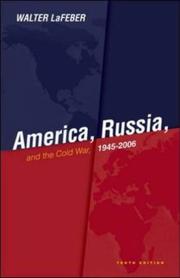
America, Russia and the cold war, 1945-1966
- Pages
- 295
- 2 editions
- First published
- 1967
- 1 language
Join or log in to shelve and rate Free, no password.
Overview
"During the American Civil War, Secretary of State William Seward predicted that Russia and the United States would confront one another on the plains of Eastern Asia--and they did in the 1890s. The rivalry of these two great nation-states heightened when the Russian Revolution added a different ideological dimension to the struggle. The Cold War is the result of that past--and the dilemmas of Soviet and American foreign policies today have a half-century of history behind them. America, Russia, and the Cold War, 1945-1966 examines the foreign policies of both countries in this historical setting. Professor LeFeber concentrates on two key periods in the Cold War--the first is the period from 1944-1946 when the situation intensified and the second is the mid-50s when it assumed a new shape. In the events of 1945 and 1946, he finds the background for Stalin's later moves in Germany and Korea as well as for the American policies which resulted in the Truman Doctrine, the Marshall Plan, and NATO. In the mid-50s, both American and Russian foreign policies began to pivot away from their focus on Europe and became concerned with the newly-emerging nations. Professor LaFeber analyzes not only the policies of both the United States and Russia but also domestic sources for these policies. For the United States, he has used extensively the newly-opened papers of John Foster Dulles as well as the papers of Harry S. Truman, Bernard Baruch, William Clayton and others who were actively involved in U.S. policy decisions."--Dust jacket.
Ratings & reviews
Log in to rate or review this book.
No written reviews yet.
Discussions
Talk about this book with other readers.
Log in to start a discussion.
No discussions yet.
Editions

Details & links
- First published
- 1967
- Pages
- 295
- Languages
- Available in 1 language
Where to buy this book: see “Buy this book”
More about this book
Read a sample, borrow it or see other editions → openlibrary.org