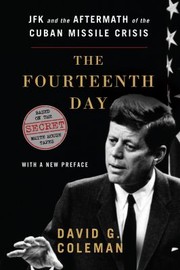
The fourteenth day
- Pages
- 256
- 2 editions
- First published
- 2012
- 1 language
Join or log in to shelve and rate Free, no password.
Overview
On October 28, 1962, Soviet Premier Nikita Khrushchev agreed to remove nuclear missiles from Cuba. Conventional wisdom has marked that day as the end of the Cuban Missile Crisis, a seminal moment in American history. As President Kennedy's secretly recorded White House tapes now reveal, the reality was not so simple. Nuclear missiles were still in Cuba, as were nuclear bombers, short-range missiles, and thousands of Soviet troops. From October 29, Kennedy had to walk a very fine line--push hard enough to get as much nuclear weaponry out of Cuba as possible, yet avoid forcing the volatile Khrushchev into a combative stance. On the domestic front, an election loomed and the press was bristling at White House "news management." Using new material from the tapes, historian David G. Coleman puts readers in the Oval Office during one of the most highly charged, and in the end most highly regarded, moments in American history.--From publisher description.
Ratings & reviews
Log in to rate or review this book.
No written reviews yet.
Discussions
Talk about this book with other readers.
Log in to start a discussion.
No discussions yet.
Editions
-
Format not known Norton & Company, Incorporated, W. W. 2012 256 pages English ISBN 9780393089226 Open Library

Details & links
- First published
- 2012
- Pages
- 256
- Languages
- Available in 1 language
Where to buy this book: see “Buy this book”
More about this book
Read a sample, borrow it or see other editions → openlibrary.org