Art & PhotographyHistoryPhilosophy & Religion
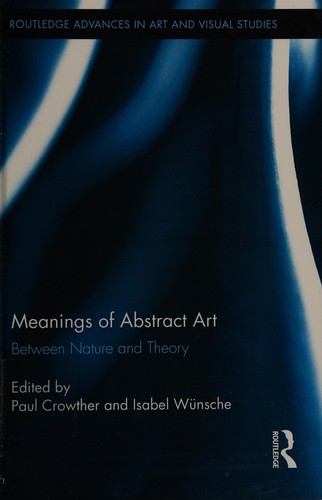
Meanings of abstract art
- Pages
- 300
- 6 editions
- First published
- 2012
- 1 language
Join or log in to shelve and rate Free, no password.
Overview
"This book explores the relation of abstract art to nature. Traditional picturing and sculpture are based on conventions of resemblance between the work and that which it is a representation "of". Abstract works, in contrast, adopt alternative modes of visual representation, or break down and reconfigure the mimetic conventions of pictorial art and sculpture. Obviously this means that abstract art takes many different forms. However, this diversity should not mask some key structural features; these center on two basic relations to nature (understanding nature in the broadest sense to comprise the world of recognisable objects, creatures, organisms, processes, and states of affairs). The first involves abstracting from nature, to give selected aspects of it a new and extremely unfamiliar appearance. The second involves abstract art as the affirmation of a relatively unconstrained natural creativity that issues in new, autonomous forms that are not constrained by mimetic conventions. (Such creativity is often attributed to the power of the unconscious.)The book contains three categories of essays: 1) those on classical modernism (Mondrian, Malevich, Kandinsky, Arp, early American abstraction), 2) those on post-war abstraction (Pollock, Still, Newman, Smithson, Noguchi, Arte Povera, Michaux, postmodern developments), and 3) those of a broader art historical and philosophical scope"--
Ratings & reviews
Log in to rate or review this book.
No written reviews yet.
Discussions
Talk about this book with other readers.
Log in to start a discussion.
No discussions yet.
Editions

Details & links
- First published
- 2012
- Pages
- 300
- Languages
- Available in 1 language
Where to buy this book: see “Buy this book”
More about this book
Read a sample, borrow it or see other editions → openlibrary.org