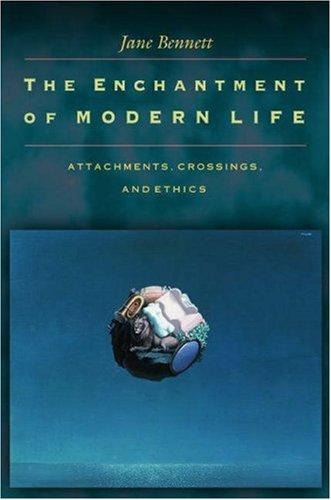
The enchantment of modern life
- Pages
- 213
- 1 edition
- First published
- 2001
- 1 language
Join or log in to shelve and rate Free, no password.
Overview
Counter It is a commonplace that the modern world cannot be experienced as enchanted--that the very concept of enchantment belongs to past ages of superstition. Jane Bennett challenges that view. She seeks to rehabilitate enchantment, showing not only how it is still possible to experience genuine wonder, but how such experience is crucial to motivating ethical behavior. A creative blend of political theory, philosophy, and literary studies, this book is a powerful and innovative contribution to an emerging interdisciplinary conversation about the deep connections between ethics, aesthetics, and politics. As Bennett describes it, enchantment is a sense of openness to the unusual, the captivating, and the disturbing in everyday life. She guides us through a wide and often surprising range of sources of enchantment, showing that we can still find enchantment in nature, for example, but also in such unexpected places as modern technology, advertising, and even bureaucracy. She then explains how everyday moments of enchantment can be cultivated to build an ethics of generosity, stimulating the emotional energy and honing the perceptual refinement necessary to follow moral codes. Throughout, Bennett draws on thinkers and writers as diverse as Kant, Schiller, Thoreau, Kafka, Marx, Weber, Adorno, and Deleuze. With its range and daring, The Enchantment of Modern Life is a provocative challenge to the centuries-old ''narrative of disenchantment,'' one that presents a new ''alter-tale'' that discloses our profound attachment to the human and nonhuman world.
Ratings & reviews
Log in to rate or review this book.
No written reviews yet.
Discussions
Talk about this book with other readers.
Log in to start a discussion.
No discussions yet.
Editions

Details & links
- First published
- 2001
- Pages
- 213
- Languages
- Available in 1 language
Where to buy this book: see “Buy this book”
More about this book
Read a sample, borrow it or see other editions → openlibrary.org