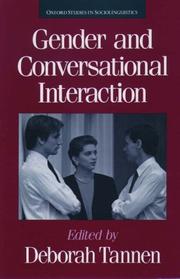
Gender and discourse
- Pages
- 216
- 3 editions
- First published
- 1994
- 1 language
Join or log in to shelve and rate Free, no password.
Overview
Deborah Tannen's You Just Don't Understand has been on the New York Times Best Seller list for nearly four years. Clearly, Tannen's insights into women's and men's conversational styles have touched a nerve. For years an internationally known and highly respected scholar in the field of linguistics, she has now become widely known for her work on how language both reflects and affects relations between men and women.
Her life work has demonstrated how close and intelligent analysis of conversation can reveal the extraordinary complexities of social relationships - including relations between men and women.
Now, in Gender and Discourse, Tannen has gathered together five of her essays on language and gender to elaborate the theoretical and empirical framework that underlies her bestselling book.
She has written an informative introduction which discusses her field of linguistics, describes the research methods she typically uses, and addresses the controversies associated with her field as well as some misrepresentations of her work. (She argues, for instance, that her approach to gender differences does not deny that men dominate women in society, nor does it ascribe gender differences to women's "essential nature.") The essays themselves cover a wide range of topics. In one, she analyzes a number of conversational strategies - such as interruption, topic raising, indirectness, and silence - and shows that, contrary to earlier work on language and gender, no strategy is linked inflexibly to dominance or powerlessness in conversation. Interruption (or overlap) can be supportive as well as dominant; silence and indirectness can express control as well as powerlessness.
The interactional context, the participants' individual styles, and the interaction of their styles, Tannen shows, all influence the balance of power.
She also provides a fascinating analysis of four groups of males and females (second-, sixth-, and tenth-grade students, and 25 year olds) conversing with their best friends, and she includes an early article co-authored with Robin Lakoff that presents a theory of conversational strategy, illustrated by analysis of dialogue in Ingmar Bergman's Scenes From a Marriage.
Readers interested in a deeper and more detailed understanding of Tannen's work will find this volume fascinating. It will be sure to interest anyone curious about the crucial yet often unnoticed role that language and gender play in our daily lives.
Ratings & reviews
Log in to rate or review this book.
No written reviews yet.
Discussions
Talk about this book with other readers.
Log in to start a discussion.
No discussions yet.
Editions


Details & links
- First published
- 1994
- Pages
- 216
- Languages
- Available in 1 language
Where to buy this book: see “Buy this book”
More about this book
Read a sample, borrow it or see other editions → openlibrary.org