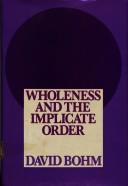
The Undivided Universe
- Pages
- 397
- 3 editions
- First published
- 1993
- 1 language
Join or log in to shelve and rate Free, no password.
Overview
In The Undivided Universe, Professor David Bohm, one of the foremost scientific thinkers of the day and one of the most distinguished physicists of his generation, presents a radically different approach to quantum theory.
With Basil Hiley, his co-author and long-time colleague, an interpretation of quantum theory is developed which gives a clear, intuitive understanding of its meaning and in which there is a coherent notion of the reality of the universe without assuming a fundamental role for the human observer.
With the aid of new concepts such as active information together with non-locality, a comprehensive account of all the basic features of quantum theory is provided, including the relativistic domain and quantum field theory. The new approach is contrasted with other commonly accepted interpretations and it is shown that paradoxical or unsatisfactory features of the other interpretations, such as the wave-particle duality and the collapse of the wave function, do not arise.
Finally, on the basis of the new interpretation, the authors make suggestions that go beyond current quantum theory and they indicate areas in which quantum theory may be expected to break down in a way that will allow for a test.
Ratings & reviews
Log in to rate or review this book.
No written reviews yet.
Discussions
Talk about this book with other readers.
Log in to start a discussion.
No discussions yet.
Editions


Details & links
- First published
- 1993
- Pages
- 397
- Languages
- Available in 1 language
Where to buy this book: see “Buy this book”
More about this book
Read a sample, borrow it or see other editions → openlibrary.org