Science of coercion
- Pages
- 208
- 5 editions
- First published
- 1994
- 1 language
Join or log in to shelve and rate Free, no password.
Overview
In this provocative study, Christopher Simpson demonstrates how the government-funded psychological warfare programs of the Cold War years underwrote the academic studies that formed the basis for much of modern communication research. U.S. psychological warfare programs in the Philippines, Middle East and Southeast Asia became essential in the creation and survival of what is widely considered to be mainstream mass communication studies.
They aided in forming the widely held preconceptions that persist today in communication studies, public opinion research, and in the types of counterinsurgency operations that are today known as "public diplomacy" and "low intensity conflict.".
Science of Coercion: Communication Research and Psychological Warfare, 1945-1960 provides the first thorough examination of the role of the CIA, Pentagon, and other U.S. security agencies in the evolution of modern communication studies. Christopher Simpson contends that it is unlikely that communication research could have emerged in its present form without regular transfusions of money from U.S. military, intelligence, and propaganda agencies during the Cold War.
These agencies saw mass communication as an instrument for persuading or dominating targeted groups in the United States and abroad; as a tool for improving military operations; and perhaps most fundamentally, as a means to extend U.S. influence more widely than ever before at a relatively modest cost. Communication research, in turn, became for a time the preferred method for testing and developing such techniques
.
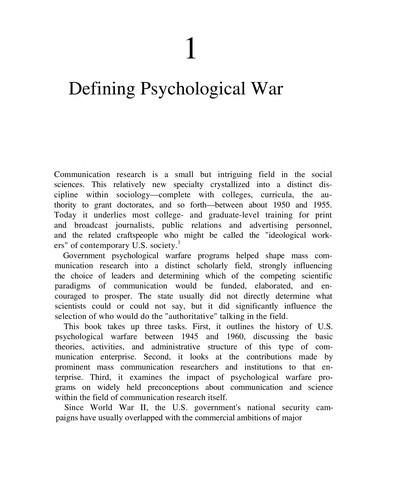
Science of Coercion outlines the history of U.S. psychological warfare between 1945 and 1960, discussing the underlying theories, activities, and administrative structure of this type of communication enterprise.
In the process, Simpson documents the role played by prominent mass communication researchers including Wilbur Schramm, Ithiel de Sola Pool, Samuel Stouffer, and Paul Lazarsfield to demonstrate the links between the so-called "founding fathers" of communication studies in the United States and psychological warfare programs.
Drawing on long-classified documents and extensive archival research, Simpson has produced a fascinating study in the history of science and the sociology of knowledge. Science of Coercion offers valuable insights into the dynamics of ideology and the social psychology of mass communication. It will provide informative reading for scholars and students of communication, the history of science, and social psychology, as well as the general reader.
Ratings & reviews
Log in to rate or review this book.
No written reviews yet.
Discussions
Talk about this book with other readers.
Log in to start a discussion.
No discussions yet.
Editions
-
Format not known Open Road Integrated Media, Inc. 2015 208 pages English ISBN 9781497672703 Open Library
-
Format not known Oxford University Press, USA 1996 214 pages English ISBN 9780195102925 Open Library


Details & links
- First published
- 1994
- Pages
- 208
- Languages
- Available in 1 language
Where to buy this book: see “Buy this book”
More about this book
Read a sample, borrow it or see other editions → openlibrary.org